All posts tagged: book review

A Spotlight on Betrayal

I’m fessing up: I didn’t read Betrayal. Mainly because I saw “Spotlight” and was afraid reading the book would be redundant. As it turns out, after talking with some of the other Bookly Clubbers, I might need to keep it on my TBR list. But in lieu of a book review, I’m here to give you my thoughts on the movie, which I was thrilled to see win Best Picture at the Oscars this year. Saying I enjoyed this movie sounds a bit strange since it’s such a disturbing story, but you know what I mean. So let’s get to what I liked/didn’t like, bullet point style. As much as I LOVE Rachel McAdams (and I really really like her), I thought her performance was a bit meh. She has a tendency to play characters that don’t seem to push her far beyond just playing Rachel McAdams. But still, I’ll see [almost] any move with her in it. (Note: DO NOT see “Aloha.”) Mark Ruffalo was GREAT. I thought he played the character well, and made Michael’s neuroses …

An Unlikeable Must-Read

Betrayal was a difficult book to read. Frankly, at times it felt like reading just a laundry list of sexual abuse crimes. Gory detail after gory detail. One after the other, after the other. You get the idea. And as I was reading my husband kept asking me, “are you liking it?” and I wouldn’t know how to answer. I’m not sure if this is a book you can “like.” It’s not one you read casually. Instead, it’s one you read out of necessity. The stories this book tells are important ones that I think everyone should know more about. To catch you up to speed, Betrayal: The Crisis in the Catholic Church was written by the Spotlight team of journalists at The Boston Globe in the early 2000’s. It unveils the Boston-area Catholic Church’s deliberate negligence and cover-up of sexual abuse crimes committed by hundreds of its clergy members, allowing them to abuse thousands of victims for decades. The book is a compilation of the 600 different Spotlight investigative reports. It’s a battery of case files, statistics, victim testimonies, and allegations. As I was reading, …

March Book

Image © NPR.org Every year Hollywood’s awards season starts in November and doesn’t end until late February. The Golden Globes, Screen Actors Guild Awards and the Academy Awards are some of the most well-known (probably because their red carpets get full E! coverage). And if you’re anything like us, you make time to watch all the fashion, speeches, glitz, and glamour of self-congratulatory Hollywood. But there’s one pattern we’ve noticed over the years, and that’s the number of nominated films that are based on books. In fact, of the 87 films awarded the Academy Award for best picture since its inception in 1928, 62 have been based on books. This year alone, seven of the eight films nominated for best picture are based on books: The Big Short, Bridge of Spies, Brooklyn, The Martian, Room, The Revenant, and Spotlight. So, as you may already know, March is our Screenplay month when we read a book that’s been made into a movie and ask ourselves the question; is the book really better than the movie? Which brings us to our book choice this …

Mending a Broken Heart

This book broke my heart over and over again. My heart broke for Eleanor, for Park, for Eleanor and Park. I was completely shattered. I was preparing myself to be totally destroyed by the ending, and then… and then came the last line of the book and I was lifted. I know Rowell was purposely vague and I am sure there are those who did not read the ending as positively as I did. But I am the eternal optimist, I’m hopeful, and I’m always searching for happy endings. So I am choosing to believe that those three words on the postcard were “I love you,” because if they weren’t, I would just simply be crushed. I know other Bookly Clubbers disagree, but I adored this book. I felt so strongly for, related to, and identified with both Eleanor and Park on so many levels that I couldn’t help but love the story. I remember being a teenager, and even a young adult to a certain extent, and wondering how it was that so-and-so felt the way they did. I also remember, like Park, feeling simultaneously protective of …

All the Feels

Confession: I read this book months ago. While details of the story might be fuzzy, how I felt about it isn’t. I devoured this book, so consumed by the relationship of Eleanor and Park that I stayed up into the wee hours, finishing it in a couple of days. I recommended it to anyone who hadn’t already been charmed by the quirky characters and the innocence of first love. This is why I love books; how it resonates – or doesn’t – with the reader varies from person to person. It’s dependent on their life experiences, who they are, what they believe, what makes them feel. For Katie C., this book didn’t resonate, a totally legitimate reaction. But for me, it took hold within the first few pages. I was what some might call a late bloomer. I didn’t have my first kiss until I was 16, my first boyfriend until 17. This kind of young love that bonded Eleanor and Park is something I’m unfamiliar with. And that might be the reason it fascinated …

Just not that into… this book

This was the first Rainbow Rowell book I’ve read. But I’ve been hearing a lot about her recently. Similar to John Green, I feel like her books have found sudden popularity in the YA world. So with all the hype, especially surrounding Eleanor & Park, I was definitely excited to read this one. I’ll be honest, I’ve never been a huge fan of YA books. Well, let me explain. A book like this is not typically my first choice, but when I have read YA books I’ve really enjoyed them. I’m not ashamed to admit I’ve read all the Hunger Games, Twilight and Divergent series, and loved each and every one of them. Anyway, I didn’t have SUPER high expectations for Eleanor & Park, but I did expect to enjoy it… unfortunately, I was wrong. Maybe it’s because I didn’t fall in love until I was in my 20’s, or maybe because I never had a high school relationship, or because by the time I was 18 I’d moved six times and never quite experienced a typical adolescence, but I couldn’t …

Shopping the Periphery

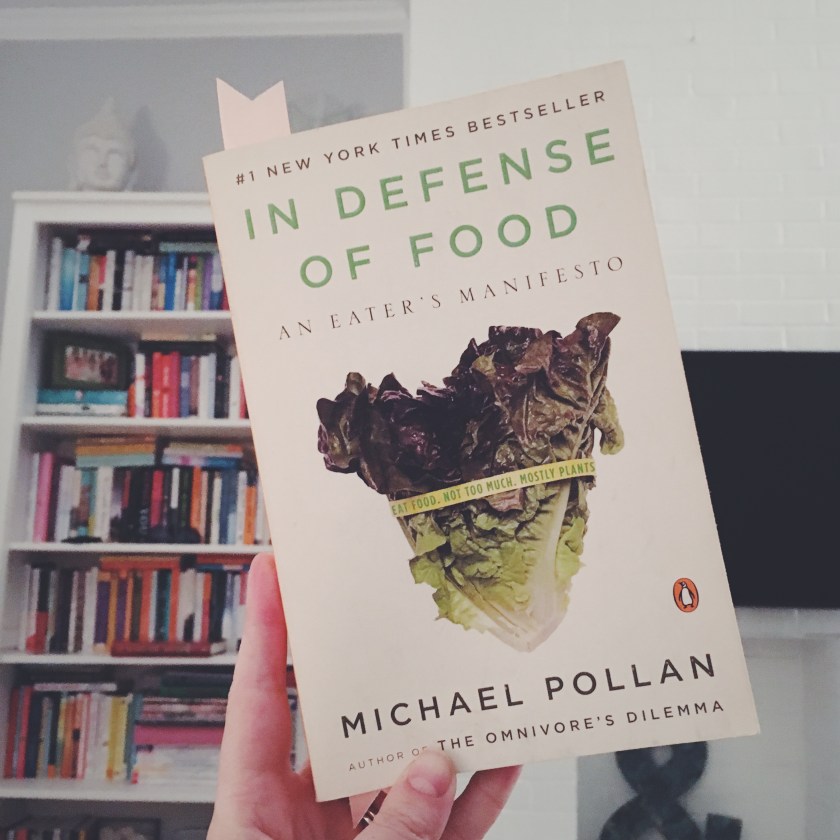
Truth time: This book wasn’t as compelling as I expected it to be. I bought it years ago, and because of my habit of buying books (much) faster than I can read them, it sat on my shelf until just a couple weeks ago. I bought it not long after it was first published, when this idea – that how we were being told to eat might not be the best way to eat – first became popular. We clearly still have a long way to go in terms of changing the accessibility and affordability of whole foods in our society. But I like to think that at least a little bit of what Pollan talked about in In Defense of Food has taken hold. Organic fruits and vegetables are a tiny bit more readily available; farmers’ markets have risen in popularity; trans fats have disappeared; more and more discussions are being had about sugar and good fats and whole grains. Some progress has been made. What I found most fascinating, if not a little …

Logic, Meet Eating

One thing I appreciate more than possibly anything else is logic. This may sound obvious, but I just simply enjoy a well-reasoned and thought out argument. To that point that I have been known to change my mind multiple times about an issue (sometimes in the span of one discussion) simply because of logical, articulate points. That said, it should come as no surprise that I loved Pollan’s book. Full disclosure: I started reading In Defense of Food almost two years ago, loved it, got distracted by a few fiction reads, and, since I felt like I had pretty much grasped the concept of the book, never returned. Until now. I reread and continued reading and found myself just as impressed as the first time. It is such a good reminder of the fact that SO MUCH of what we as Americans are ingesting is not even food. Pollan points this out throughout the book and it’s worth repeating: we are not eating food. We are eating food product. I was about to make a …

Confused Eater

Hi all, long time no talk to. I hope your holidays were merry and bright… and you came away with plenty of new books to enjoy in 2016! Over the holidays I finished our December / January read: In Defense of Food by Michael Pollan. Our goal with this selection was to learn something new for the new year. And that I did. Pollan’s book was a very interesting look into our eating habits and the food trends we’re exposed to as modern Americans. Pollan sheds light on the food industry as just another profitable business. If you think about it, this makes sense. Those operating in food-based industries are part of a competitive marketplace just like any other. So, as a result, producers make claims and alter their products to out sell the “other guy.” Although it’s a disheartening view, it’s good to be aware of this reality and to think before we eat. However, reading this book left me feeling more overwhelmed than anything. There are so many layers to the food industry, true and …

Underwhelmed

When I read Katie C.’s review last week, I immediately texted the other Bookly Clubbers and said “uh oh, my review is going to look a lot like yours!” I started Tell the Wolves I’m Home on November 10. I didn’t finish until yesterday, which for me is a very long read. Usually, I pick up a book and in a few sittings over the course of 3-4 days, I’m done. I just couldn’t get into this one. Don’t get me wrong, Brunt’s style is enjoyable, the characters were well-developed, and the idea of the book, the story, was touching and I should have love it. However, I didn’t. I wanted to be on June’s side, but I couldn’t relate to her – even when I put myself back in my 14-year-old shoes, I didn’t feel a connection to her. Her relationship with Greta was fascinating, but Greta herself made me so angry. I think if I had understood Greta’s point of view better, if she had narrated for a bit or we got to “read her …