Hello again! Feel like a good laugh after last month’s read? Well, you’re in luck! In honor of April Fool’s Day and the month of foolish pranks, it’s the perfect time for us to read something funny. April’s theme is humor and we’ll be reading Hyperbole and a Half by Allie Brosh.
Never heard of it? Well, let us explain. It all started out as a web comic and blog by the same name. The author, Allie Brosh, is in her late 20’s and lives in Oregon with her husband and 2 dogs (who appear often in her drawings). She used (uses) her unique, hand-drawn web comic / blog to tell her life stories and struggles in a humorous, self-deprecating and creative way. The first thing you notice is probably her drawing style which is usually described as “crude” because of its juvenile look. But the Hyperbole and a Half blog has received up to 5 million views per month and attracted many loyal readers. So in 2013 she published her first book Hyperbole and a Half: Unfortunate Situations, Flawed Coping Mechanisms, Mayhem, and Other Things That Happened.
This book is a lot like her blog as it tells stories from both her childhood and present-day life. It’s also similar in the way she doesn’t hide from real issues and some personal health battles. For example, Allie has struggled with depression in the past, and she tells that story candidly on the blog and her book. But what makes her story so charming is the goofy way in which she illustrates these anecdotes.
Here’s a look at an interview by The New York Times with Allie Brosh for more on Hyperbole and a Half:
In case you’ve already read this month’s book, here are some other good humor book recommendations:
We hope you’ll join in and read/laugh with us this month! And here’s a fun playlist to listen to while enjoying Hyperbole and a Half…
I am admittedly the Kathryn who may be a tad more on the “dead inside” end of the spectrum. Rarely do movies, books, songs, etc move me at tears. That being said, while Still Alice is a very poignant look into the interworking of a family as a disease tears them apart physically, mentally, and emotionally, I felt somewhat disconnected from it. Perhaps some of that disconnect was intentional on the part of Lisa Genova who writes in a decidedly third person perspective on a deeply personal disease. Perhaps we are meant to feel like outsiders as a way of sharing in Alice’s disconnect from her life, forced to be an outsider by her disease. Then again, perhaps I am over thinking it.
Looking back, I didn’t really love the writing style. Very staccato and foreshortened, it made for an easy read. Similarly, Genova did not spend much time expanding on somewhat played out archetypes in her characters. There is the daughter that is passionate but rebellious. There is the daughter that is straight and narrow but kind of a brat. There is the sometimes overbearing but well-intentioned mother. The father is hardworking but aloof. Also, there is a bonus son who helps round-out the family just by being present. Perhaps Genova is not one to flourish her works with mold breaking characters and linguistic stylistics that sometimes add to but often clog up one’s writing. Ultimately, though, I think this lent itself to the subject as the story and Alice’s decline is very rapid fire and intense. It may have been like taking a big bite of steak and chewing it all at once with one dry swallow if it had been more stylishly written.
While I didn’t particularly fall in love with Genova’s style, I do like the subtlety with which she built her metaphors. It was all hidden between the lines. Alice seemed driven to crack Lydia of her intense connection with make-believe. Alice believe in science, numbers, charts, data. She simply could not understand Lydia’s desire to act. In the end, after her memories were lost and she was no longer grounded in her prior reality of charts, numbers, and data did her bond with Lydia grow. Alice’s life was now like one of Lydia’s plays acted out in front of her by strangers cast as her family. Genova also challenges the readers to accept imperfect characters. John is the perfect imperfect scapegoat. He is a man easy to judge. How could he blah? Why didn’t he blah? Could you though? Truthfully?
All in all, not a book I would read again but a challenging subject.
I read Still Alice over the course of two days while on vacation during my spring break from teaching. I know – not quite the beach read you’d expect. It felt a little awkward crying on the beach while everyone around me was enjoying the sun and sand, but it was worth it.
I appreciated the pacing – it was such a fast read, and I loved the perspective of the novel as well as some of the storytelling devices that Genova used to really show Alice’s view. Specifically, the repetition of chunks of texts, sometimes whole paragraphs – it really places the reader in Alice’s shoes. For example, at the lunch lecture, you feel through Alice the awareness that something is off, but experience the lack of awareness of what that is. Don’t get me wrong – it can be uncomfortable to have an understanding as the reader that the narrator does not have, but it was a very interesting, eye-opening, and in many ways necessary approach to telling the story of Alice. It’s interesting that Genova points out (via Dr. Davis) that Alice won’t always be reliable, and it’s her perspective that we read. It brings up the question, how much can we trust what we read?
Perhaps what I enjoyed most about the book was the development of Alice and Lydia’s relationship. When I made notes to myself about what I wanted to say, I had written “Lydia’s development/growth,” but that’s not really it. What I loved was how Lydia and Alice were able to not just reconnect, but to, in many ways, form an entirely new relationship. Though Lydia seemed like the black sheep, she was the one most able to relate to Alice, and Alice seemed to find comfort in her ability to bond with Lydia while the disease was progressing. I loved that she always seemed to be on Alice’s side and didn’t treat her like a patient – she still treated her like a person.
The other device that Genova used was Alice’s questions. We got to see throughout the book how Alice went from being able to respond to the questions in detail to only being able to provide vague allusions to the correct answers. After she froze her Blackberry, we see nothing more of the questions until the scene with John. He begins to ask Alice the questions without telling her why or that she wrote them herself. Later, when she finds the butterfly folder and you learn of her intentions, I had my first feeling of sympathy and love for John. I think, or maybe I’d just like to believe, that he found the butterfly folder first, and when he realized that Alice couldn’t answer her questions, he made it impossible for her to follow through on her plan (which is why she couldn’t find the pills in her bedside table). If this is true, then it shows that John wasn’t ready to lose Alice, even though he was doing a poor job of showing it. After an entire book of feeling uncertain about John, his treatment of Alice, and his method of coping with her illness, it was a moment where I truly felt for him and where his love for Alice showed through.
My hunch is I’m one of the few who feels the way I do about this book. Let’s see if I’m right…
Admittedly, until we chose this as our March book I wasn’t going to read it. Mainly because the idea of this happening to someone I love made me want to ignore anything having to do with it.
Plus, after hearing what a handful of my friends thought of “Still Alice,” my fears of this being an emotional and heartbreaking read were only amplified.
So I readied myself with a box of tissues, a few hours of privacy, and got to reading.
But I was actually surprised by how unemotional it left me. As someone who cries easily, I expected to be more moved by Alice’s story and have spent some time trying to figure out why I wasn’t. I think a big part of it is because it was told from her point of view, we didn’t experience much of how the family was affected. And with this type of disease, that’s arguably the hardest part.
I was also hoping to connect to Alice and her story on a personal level, since I myself live with a disease – one that, like Alzheimer’s, doesn’t have a cure. But there’s a big difference between cystic fibrosis – a disease that can be very physically difficult but leaves your mind untouched – and Alzheimer’s.
One thing that did really resonate with me was the significance of the butterfly (something I wish was used a little more throughout the story).
“She liked being reminded of butterflies. She remembered being six or seven and crying over the fates of the butterflies in her yard after learning that they lived for only a few days. Her mother had comforted her and told her not to be sad for the butterflies, that just because their lives were short didn’t mean they were tragic. Watching them flying in the warm sun among the daisies in their garden, her mother had said to her, See, they have a beautiful life.”
This perspective, that a life isn’t measured by its length but rather by its depth, is something I hold on to when things get hard. It’s also a good reminder of what matters: HOW we live our life and the richness of each day, rather than the age we get to reach.
I hope I’m not coming off as too cold-hearted. I definitely felt saddened and sympathetic to Alice’s horrific situation. I just wasn’t as emotionally impacted as I thought I would be judging from others’ reactions. Kind of like how people talk and talk and talk about how amazing a movie is, making it impossible to live up to.
Overall, I enjoyed the book and would recommend others add it to their “to read” lists. It was a super quick read, one that had me anxiously turning the pages.
Don’t forget to chime in on our group discussion! And stay tuned for April’s pick.
I liked this book a lot.
I’m hesitant to say loved, it’s not really the kind of story you can love (let’s be honest, it’s sad). But I really enjoyed Genova’s writing style, the characters and the way she told Alice’s story.
It’s hard for me to separate my experience reading this book from my experience with Alzheimer’s disease. So first I’ll share a bit about my experience…
I’ve witnessed the disease first-hand. A member of my family suffered from Alzheimer’s years ago. I was younger than 10 when she passed-away (if I remember correctly). But she’d been gone a long time by then. The hardest part of it all was to watch her forget the people around her. Her own children even. I think Alzheimer’s is uniquely cruel in that regard. It’s hard enough to watch someone you love struggle with illness, it’s especially vicious when the disease takes away any memory of the love you share.
Given my experience, this book was a difficult read. But I knew that going in. I think ultimately it made me more hopeful than sad. I love that Genova stayed with Alice the whole way through… she never strayed to someone else’s perspective. And the story she told left me comforted, in a way. Alice could still find happiness. She never forgot what it was to live. Who knows, maybe it’s because this story isn’t nearly as dark as experiencing the real thing? But I didn’t find Alice’s story as desperate as I thought I would.
Also, I think Genova was able to make Alice relatable on many different levels. Sure, I’m now second-guessing myself every time I walk into a room and forget why I’m there (am I showing early symptoms?). But there were other human elements to Alice’s story that I related to, strongly. This quote for example jumped right of the page and hit me head-on:
“She had no classes to teach, no grants to write, no new research to conduct, no conferences to attend, and no invited lectures to give. Ever again. She felt like the biggest part of her self, the part she’s praised and polished regularly on its mighty pedestal had died. And the other, smaller, less admired parts of her self wailed with self-pitying grief, wondering how they would matter at all without it.”
I’m at a point in my life where this just about says it all. When your career takes on a new look, things don’t turn out according to plan, or you turn down an unexpected path, then what? Who are you now? What do you do? I think that was the bigger message for me… Alice, at her core, didn’t change, she just had to readjust. That’s why I LOVED the ending. It was so perfect that the book ends with Lydia eager for her mother’s opinion. Alice said all along that she’s still herself, she still holds thoughts and opinions. She still holds value. Alzheimer’s doesn’t take everything.
How many fairy tales have been made into movies? Too many to count, so we won’t. But let’s add to the list Disney’s new live-action version of Cinderella. Given that this is another in a very long line of Cinderella remakes, it surprised us with great reviews and opening numbers. Although maybe it shouldn’t considering it was directed by Kenneth Branagh (Academy Award nominated actor and director). It premiered mid-March outdoing Fifty Shades of Grey with a $135 million opening weekend. AND it scored 84% on rotten tomatoes. We guess there’s no denying fairy tales are a hit. But does anyone even remember where they came from?
Fairy tales started as short stories filled with folkloric characters portraying a certain legend or lore. They were found in all different cultures, each with its own take on particular life lessons, and they weren’t too kid-friendly. In one of the oldest tales of Cinderella for example, she is a slave girl from Thrace. And, well, it’s not the ‘fairy tale’ story we know today. In fact, some think it was the story of a real woman who was sought out by the Emperor and then, more-or-less, she was trafficked for sex and comfort. No folks, no pumpkin, handsome prince or glass slipper in this version. The story evolved, obviously. However, not before making a few more gruesome stops. At one point Cinderella’s story was about cannibalism. Yep. Cinderella and her sisters suffer a terrible famine, so they attempt to kill and then eat their mother. Apparently Cinderella wasn’t always so nice. Although, to be fair, she doesn’t go through with eating her mother, her sisters do. But she does wear her bones as an accessory to the ball. Up-beat, right?
Vanity Fair
Well, French author Charles Perrault gets ahold of Cinderella’s tale and his version creates the rags-to-riches story we’re all familiar with (we assume). Written in 1697, Perrault adds the pumpkin carriage, glass slipper, fairy godmother, and many other Disney-esque features so closely linked to Cinderella. And eventually this romanticized version of Cinderella’s story falls in the hands of Walt Disney. Disney did their version of Cinderella in the 50’s and brought it to the screen. Thanks to Walt, we now think of this fair tale, and many others, as a story of love, romance, ball gowns, magic wands, and helpful woodland creatures. Oh, and that some day our prince will come and rescue us from our domestic obligations. But only to perform the same chores, albeit in a castle. Let’s call it climbing the domestic ladder.
Once upon a time fairy tales were about conflict, gender politics, feminism, anti-feminism, survival, etc. Now, they’re princess tales and they’re being redone over, and over, and over, and over again. But whether or not this live-action Cinderella redux makes a good movie, have fairy tales strayed too far from the original books? Eh. Who’s to say one version’s better than the other? To each their own. BUT, what would a modern interpretation of the original Cinderella fairy tale look like? That, we’d like to know.
Hello! I’m sure you recognize these images as the poster for the movie and the original book cover. The movie poster was re-purposed to serve as a book cover shortly after the film was produced… and, well, there’s nothing I hate more than a “now a major motion picture” book cover!
I get it. If you make a movie of it you want to show it off. But inevitably the “motion picture” cover ends up looking like a cheap ad (admittedly, I’ve seen worse). In the case of Still Alice I definitely like the original butterfly cover best, and it pulls from a good theme in the book. But I figured the cover could use a makeover. Granted, this won’t always be the case with every book we read for Bookly, but for Still Alice I designed TWO new cover options…
“She spotted her running shoes on the floor next to the back door. A run would make her feel better. That was what she needed. Ideally, she ran every day.”
Alice is a character of such intelligence and motivation, and suddenly she finds herself losing her every day independence; a trait that defines so much of who she is. Was? And the first time we witness her symptoms is when she’s out for one of her routine runs. This cover represents that loss and Alice’s inevitable disappearance.
“The low-branched beech tree towered at least one hundred feet above them and wore beautiful, glossy deep purplish green leaves in the spring, summer, and fall. But now, in January, its leafless, black branches cast long, distorted shadows on her family’s graves, and it looked perfectly creepy.”
If we’re being honest, I like this second cover better. I think it looks more like the story to me… if that makes any sense.
The scene when Alice and John make their visit her mother and sister’s grave site (and father) was so powerful. I think Alice’s approach to that scene says a lot about her character and her story. Although it’s a visit she makes every year, and so much looks the same as it always does, this year there’s deeper meaning in those memories and the gravestones.
{all cover photography art and photography is my own}
Which cover do you like better? I’d love to hear from you!
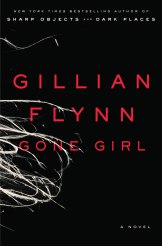
If you haven’t heard of Gillian Flynn, or at least Gone Girl, we can just assume you’ve been living under a rock for the past few years. But assuming you do know about her books, and the latest movie, do you also know about the other movies in the works, the TV show, and the sequel? Well, read on and we’ll fill you in…
First, in case you’ve recently come out from under the aforementioned rock to join civilization, here’s what you need to know about Gillian Flynn…
She’s an author, and now also a screenwriter, who was born in Kansas City, Missouri (where a lot of her books take place). As a young girl she was painfully shy and escaped into the world of books and the horror films her father took her to see. Such interests have molded her into an author of uniquely dark fiction that takes seemingly normal towns filled with seemingly normal people and twists it into something deliciously eerie and broken. Initially she attempted a career in police journalism after getting a Masters in degree in Journalism from Northwestern University. Shortly thereafter, realizing it wasn’t her strength, Flynn moved on to entertainment journalism working for Entertainment Weekly where she wrote about films for 10 years. Fortunate for us, she was laid-off in 2008 and shifted focus to promoting and publishing the 3 books she’d written during her downtime with EW.
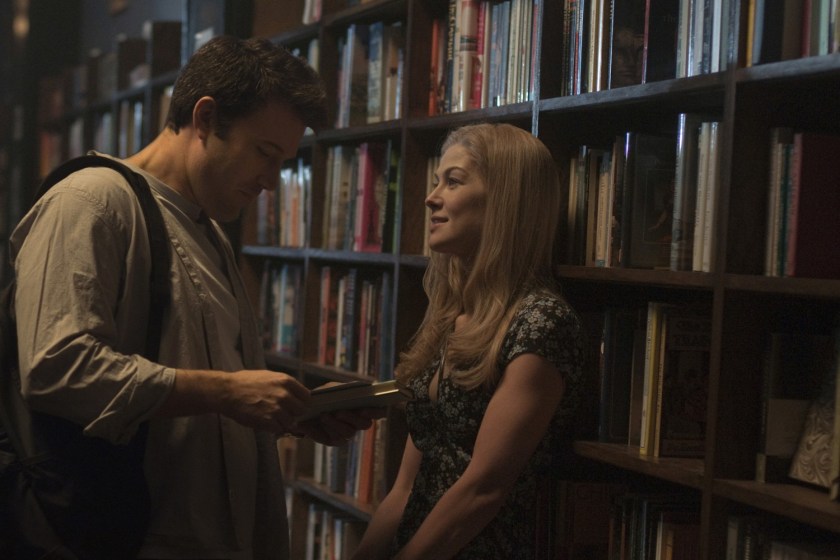
All three books, Sharp Objects (2006), Dark Places (2009) and Gone Girl (2012), pull you deep into a richly dark story with numerous twists and turns told from the perspective of a woman with a layered past. These novels have each done so well individually, but most notably Gone Girl has reached unmatched success with over 8 million copies sold and a film adaptation which grossed over $350 million. It’s a tricky story to tell on film, but to the credit of director David Fincher (of The Social Network and Fight Club fame) he worked with Flynn as the screenwriter for the entire film.
And now both Sharp Objects and Dark Places are being brought to the screen. Sharp Objects is being turned into a one-hour serialized drama for television. A perfect fit for this “golden age” of television. The producers have had the rights since 2010 as they struggled between whether to tell the story as a feature film or television program. So maybe they’ll end up with a movie after all, who knows? But hopefully this comes to air sooner rather than later. And rumor has it they hope to cast Kiernan Shipka as the antagonist.
Also, filming for Dark Places has already wrapped, staring Charliez Theron and Chloe Mortez. And in fact, without advanced notice, the trailer was just released in France where it will premier in just one month. Theron’s definitely not what we’d pictured for Libby Day (Kate Mara would have been our first choice), and why is she wearing that trucker hat in every scene? Originally the film was set for release in the US this fall, but with the Gone Girl buzz still very much alive in the media it’s been pushed to next spring. And although Flynn didn’t write the script for this adaptation, she’s apparently given it her seal of approval.
And there’s even talk of a Gone Girl sequel! It’s true. If you’ve read the book or seen the movie you know that the ending reads a bit more like the start of a new chapter than the end of another. So Flynn has said that if the whole team was on-board (Affleck, Pike and Fincher) she’d be in for a sequel. Fingers crossed!
Ultimately it’s the strong, flawed, cunning, smart, powerfully broken female characters that bring us back to Flynn’s work. She manages to capture their inner most thoughts so fully—good, bad and ugly—that she’s even received criticism for creating female protagonists who are too unflattering. Well, in the words of Flynn, ″The one thing that really frustrates me is this idea that women are innately good, innately nurturing.″ We’ve loved reading Gillian Flynn’s books, and can’t wait to see more of her beautiful characters on the pages and up on screen. Thanks for reading!
It’s finally here, our first Bookly Club book! First things first. As you may already know, each book we read is meant to fit the time of year in which we read it. And the theme for this month is “Screenplay.”
Did you spend any time this winter watching the Golden Globes, SAG Awards or Oscars? Well, we just passed awards season, and since we’re stuck in bitterly-cold climates (if you’re not, count yourself lucky) those shows were among the few highlights during this sub-zero season. So in honor of Hollywood’s recent self-congratulations, we’re reading a book that’s been made into a movie.
In fact, this book has been made into an award-winning film which has won a lot of praise during the most recent awards season. Published in 2009, Still Aliceis a story of a woman actively fighting her battle with early-onset Alzheimer’s disease. A terrifying illness affecting millions. The first-time author, Lisa Genova, has her Ph.D. in neuroscience from Harvard University and tells the compelling story of 50-year-old Alice Howland’s demise into the frightening world of forgetting. It seems like this will be a really hard story to read, especially for those who’ve been affected by the disease. The book should probably come with a disclaimer as to how many tissue boxes should be purchased before reading. But hopefully Alice’s story will also be an inspiring one.
It must be powerful considering the attention and praise Julianne Moore has been getting for her portrayal of Alice Howland. The film premiered last month to critical acclaim (90% on Rotten Tomatoes for those of us who obsessively check the “Tomatometer” before going to the movies). In fact, Julianne Moore just won the Oscar for Best Actress for her performance in the film. Hopefully one of us will make it out to the theater during this month’s read to compare the book to the onscreen version. Check out this preview (tissues at the ready)…
We’re very excited to start Still Alice. Not just because it’s the first Bookly Club book (yay!), but because it seems like a great read, one we hope you’ll read with us. And when you curl up in your favorite spot with a hot mug of [insert preferred hot beverage here] and a comfy blanket, here’s the perfect playlist to listen to for this month’s read:
Stay tuned for our reviews of Still Alice at the end of the month, and visit Bookly throughout the month for other book-related posts. Also, feel free to reach out, ask questions, or make recommendations for next month’s humorous “Joke’s On You” book. Thanks for reading!
And if you’ve already read this month’s book, here are some suggestions for other great books made into movies (granted, the books are usually better than the movie)…
If you love the smell of rich old books, the sound of turning a page, the creative power of cover design, or the satisfaction of putting a good book up on the shelf like hanging a picture of a happy memory you will want to watch this film. If not, you need to watch this film.
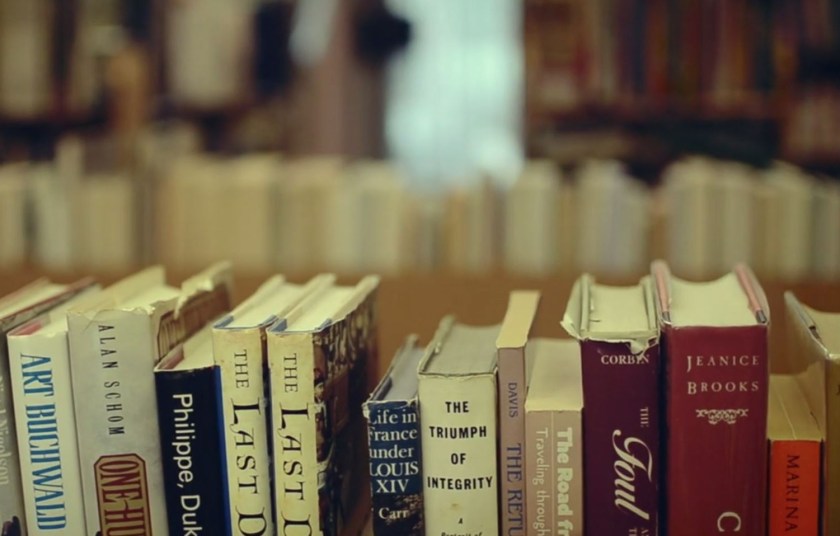
What is the future of the printed book? Hanah Ryu Chung examines this question in the student film Epilogue – The Future of Printwith a beautiful appreciation for the art and craft of book making and the experience of reading. Chung explores the city of Toronto and its close-knit community of independent booksellers (maybe the printed word’s biggest fans) and asks them where they believe the printed page is going.


 Never heard of it? Well, let us explain. It all started out as a web comic and blog by the same name. The author, Allie Brosh, is in her late 20’s and lives in Oregon with her husband and 2 dogs (who appear often in her drawings). She used (uses) her unique, hand-drawn web comic / blog to tell her life stories and struggles in a humorous, self-deprecating and creative way. The first thing you notice is probably her drawing style which is usually described as “crude” because of its juvenile look. But the Hyperbole and a Half blog has received up to 5 million views per month and attracted many loyal readers. So in 2013 she published her first book Hyperbole and a Half: Unfortunate Situations, Flawed Coping Mechanisms, Mayhem, and Other Things That Happened.






 thebooklyclub.com