All posts tagged: nonfiction

An Unlikeable Must-Read

Betrayal was a difficult book to read. Frankly, at times it felt like reading just a laundry list of sexual abuse crimes. Gory detail after gory detail. One after the other, after the other. You get the idea. And as I was reading my husband kept asking me, “are you liking it?” and I wouldn’t know how to answer. I’m not sure if this is a book you can “like.” It’s not one you read casually. Instead, it’s one you read out of necessity. The stories this book tells are important ones that I think everyone should know more about. To catch you up to speed, Betrayal: The Crisis in the Catholic Church was written by the Spotlight team of journalists at The Boston Globe in the early 2000’s. It unveils the Boston-area Catholic Church’s deliberate negligence and cover-up of sexual abuse crimes committed by hundreds of its clergy members, allowing them to abuse thousands of victims for decades. The book is a compilation of the 600 different Spotlight investigative reports. It’s a battery of case files, statistics, victim testimonies, and allegations. As I was reading, …

March Book

Image © NPR.org Every year Hollywood’s awards season starts in November and doesn’t end until late February. The Golden Globes, Screen Actors Guild Awards and the Academy Awards are some of the most well-known (probably because their red carpets get full E! coverage). And if you’re anything like us, you make time to watch all the fashion, speeches, glitz, and glamour of self-congratulatory Hollywood. But there’s one pattern we’ve noticed over the years, and that’s the number of nominated films that are based on books. In fact, of the 87 films awarded the Academy Award for best picture since its inception in 1928, 62 have been based on books. This year alone, seven of the eight films nominated for best picture are based on books: The Big Short, Bridge of Spies, Brooklyn, The Martian, Room, The Revenant, and Spotlight. So, as you may already know, March is our Screenplay month when we read a book that’s been made into a movie and ask ourselves the question; is the book really better than the movie? Which brings us to our book choice this …

Shopping the Periphery

Truth time: This book wasn’t as compelling as I expected it to be. I bought it years ago, and because of my habit of buying books (much) faster than I can read them, it sat on my shelf until just a couple weeks ago. I bought it not long after it was first published, when this idea – that how we were being told to eat might not be the best way to eat – first became popular. We clearly still have a long way to go in terms of changing the accessibility and affordability of whole foods in our society. But I like to think that at least a little bit of what Pollan talked about in In Defense of Food has taken hold. Organic fruits and vegetables are a tiny bit more readily available; farmers’ markets have risen in popularity; trans fats have disappeared; more and more discussions are being had about sugar and good fats and whole grains. Some progress has been made. What I found most fascinating, if not a little …

Logic, Meet Eating

One thing I appreciate more than possibly anything else is logic. This may sound obvious, but I just simply enjoy a well-reasoned and thought out argument. To that point that I have been known to change my mind multiple times about an issue (sometimes in the span of one discussion) simply because of logical, articulate points. That said, it should come as no surprise that I loved Pollan’s book. Full disclosure: I started reading In Defense of Food almost two years ago, loved it, got distracted by a few fiction reads, and, since I felt like I had pretty much grasped the concept of the book, never returned. Until now. I reread and continued reading and found myself just as impressed as the first time. It is such a good reminder of the fact that SO MUCH of what we as Americans are ingesting is not even food. Pollan points this out throughout the book and it’s worth repeating: we are not eating food. We are eating food product. I was about to make a …

Confused Eater

Hi all, long time no talk to. I hope your holidays were merry and bright… and you came away with plenty of new books to enjoy in 2016! Over the holidays I finished our December / January read: In Defense of Food by Michael Pollan. Our goal with this selection was to learn something new for the new year. And that I did. Pollan’s book was a very interesting look into our eating habits and the food trends we’re exposed to as modern Americans. Pollan sheds light on the food industry as just another profitable business. If you think about it, this makes sense. Those operating in food-based industries are part of a competitive marketplace just like any other. So, as a result, producers make claims and alter their products to out sell the “other guy.” Although it’s a disheartening view, it’s good to be aware of this reality and to think before we eat. However, reading this book left me feeling more overwhelmed than anything. There are so many layers to the food industry, true and …

December / January Book

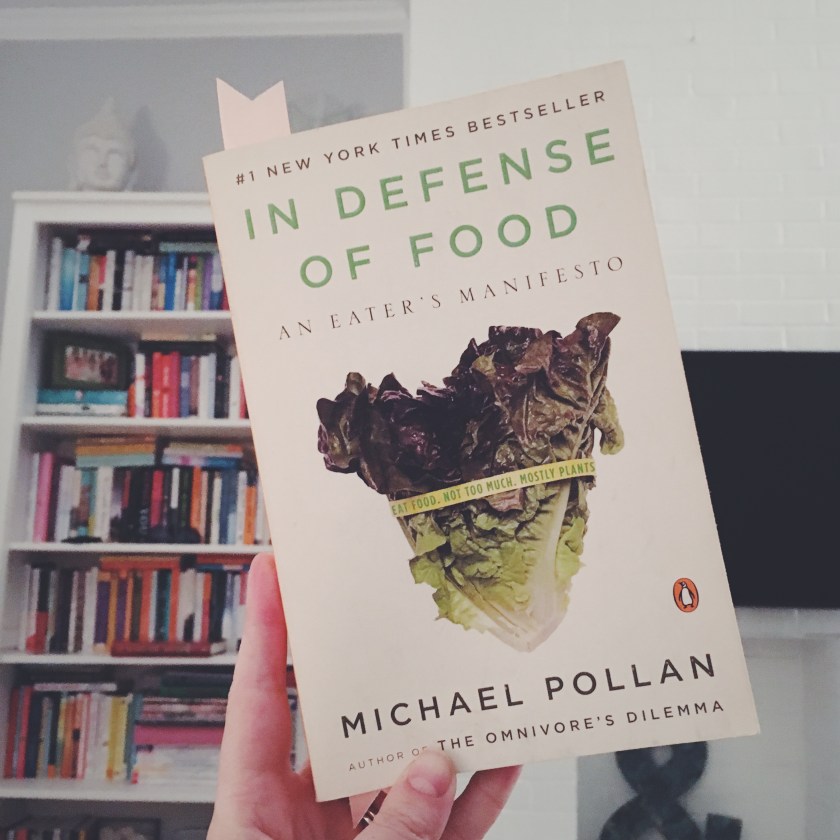
Book map / sketch © Austin Kleon With 2015 coming to a close, we decided our December / January pick will be a New Year’s resolution of sorts. Not to mention how busy things get during these months, hence the combining of December and January. Anyway, our resolution is to learn something new. So for these months we’ll be choosing a non-fiction book to begin 2016 with something new and different. Without further delay… this month(s)’ pick is Michael Pollan’s #1 New York Times Bestseller In Defense of Food: An Eater’s Manifesto. Pollan is an American journalist, activist and author. His books focus on our country’s growing dilemma with food, its process, the way we eat, and what we eat. In one of his earlier books published in 2006, An Omnivore’s Dilemma, Pollan established a critique of how agribusiness have lost touch with the natural cycles of farming, wherein livestock and crops intertwine in mutually beneficial circles. His perspectives on food, farming, and our consumptions are unique, controversial and modern. Our selection, In Defense of Food published in 2008, …

Feminism: Should We Be Over It?

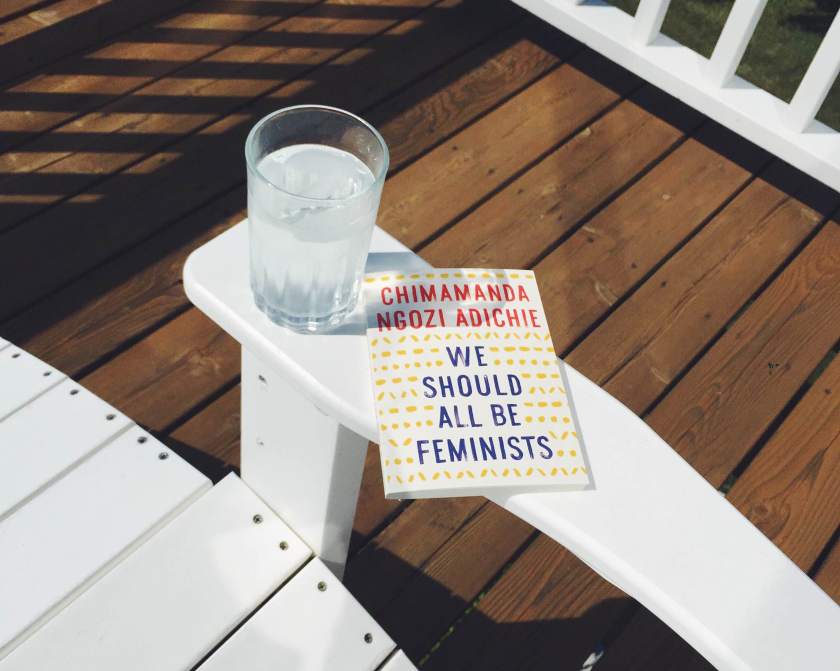
“My own definition of a feminist is a man or a woman who says, ‘Yes, there’s a problem with gender as it is today and we must fix it, we must do better.’ All of us, women and men, must do better.” – Chimamanda Ngozi Adichie I went into this book with high expectations (maybe I should start lowering them a bit…). I’ve been on intrigued by the topic of feminism recently – I’m currently in the middle of Bad Feminist and have recently started listening to the “Call Your Girlfriend” podcast – so I was eager to see what Chimamanda Ngozi Adichie had to add to the conversation. And while I realize it’s hard to fit much of anything into a mere 52 pages, it left me feeling a bit empty. Because this only brushes the surface of the discussion. After reading the other Katherine/Kathryn/Kathryn reviews, I realized I was in the minority with my feelings on feminism today. I agree that in many ways this subject is tired. Put it to bed already! Right? But unfortunately …

Yes, We SHOULD All Be Feminists.

As I read Chimamanda Ngozi Adichie’s TEDx talk and then Katherine C.’s review, one word just kept repeating in my head: “yes.” Yes to being unapologetic in our femininity – you can enjoy being feminine and still be a feminist. Yes to raising our daughters and our sons differently so they may enjoy a world where men and women are equal. Yes to equal pay and all the other benefits that go along with women having the same rights as men. Yes to embracing feminism and recognizing that being a feminist simply means supporting the basic principle that women should have the same rights and opportunities as men have. Yes to all of it. All that being said, I do feel lucky that in the United States we have at least come far enough that some of the issues Adichie describes in Nigeria do not exist. But what kind of praise is that? “Well, at least when I tip someone the tipped thanks me and not my husband” is not quite a glowing recommendation for …

Feminism: I know you are but what am I?

I agree with Katherine C.  I’m bored of this conversation.  That is not necessarily a critique of Adichie’s writing or thoughts. It just that it is just that – writing and thoughts.  Frankly, you have to be the most isolated naïve person (male or female) to not appreciate the glaring discrepancies in gender equality.  I am not just speaking to places in the world, like Nigeria, where these social constraints are newly being addressed.  I am talking about here at home.  We all see it and live it every day.  I get called “nurse,” “honey,” “blue eyes” on the daily at work.  But, you know what, it doesn’t bother me all that much because 1. I have bigger fish to fry and 2. I can’t let it. As much as the concept of feminism is marred with a negative societal connotation of a movement of the brashy broad juiced up on hormones and self-rightoutsness, the real problem is simple.  The real problem is that feminism is not anything.  It isn’t an action.  It isn’t change. Feminism …

Why aren’t we all feminists already?

This was an interesting read. It made me think a lot about how I define feminism. Author, or speaker rather, Chimamanda Ngozi Adichie had a beautiful way of articulating complex issues and crystallizing her point for a diverse audience. I definitely enjoyed the read, but I think she only skimmed the surface. Which is unfortunately the current status of feminism in our county. In my opinion, the conversation she provokes in We Should All Be Feminists is the same one we’ve been having for 30 years. Yadda, yadda. Personally, I’m done with this broken record. Take it out of rotation. Let’s get on board with the issues already and elevate the conversation. Don’t get me wrong, I liked all of Adichie’s points… It’s time the word feminism retained less of a negative connotation. In fact, it should have a positive connotation. And we should raise our daughters to a higher standard, instead of asking them to shrink themselves into smaller, more feminine, role. And all this change is within our control, “culture does not make people. People make people.” But …