Latest Posts

Unburying the Osage

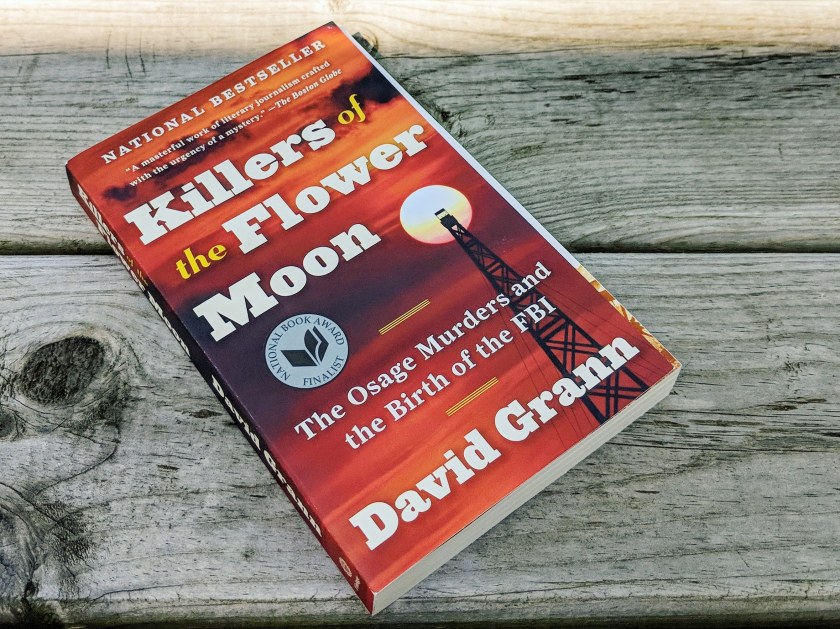
It is wild to me that I had never heard even a peep about the Osage murders until I picked Killers of the Flower Moon. And I guess, in some ways, that’s the point of the book. An entire group of people targeted and being systematically murdered for money and it’s been completely washed out of our history for everyone but those personally touched by it.

The story told in this book is almost so wild that it’s unbelievable, and the craziest part is that what has been told is probably not even the half of it! I feel gross using the word “fascinating” to describe it, but… It’s truly fascinating that 1) all of this actually happened, 2) basically everyone got away with it, and 3) there are probably hundreds more victims that we will never even know about.

Aside from the story itself, I also really enjoyed how Grann laid it out, unfolding it bit by bit, seemingly allowing us to discover the webs and cover-ups the same way he did. I won’t lie – I definitely had trouble keeping all the “players” straight and more than once had to go back and remind myself who was whom. I’m also a very fast reader, but Killers of the Flower Moon took me a looooong time. Not because it was bad or slow, but it is dense. And I found that I couldn’t read it fast.

I often have trouble with nonfiction in the summer. I find myself wanting to devour 100 silly, easy novels rather than one serious nonfiction text. With that said, I’d still highly recommend Killers of the Flower Moon. But if you’re like me and you want your summer reads to be just this side of trash, maybe wait until the leaves start to change 🙂

picture of a book on a coffee table with a mug of coffee

An Eye-Opening True Story

While this book was a little outside of my usual comfort zone, I’d heard so many good things that I decided I had to give it a try. And I’m glad I did.

Both disturbing and informative, Killers of the Flower Moon tells a true story I knew very little about. The devastating murders of hundreds of members of the Osage Nation is a shameful part of our history, but one we should all be aware of — and something that should be taught in schools.

This book is an entertaining and educational blend of true crime and history, a genre I want to read more of. Grann is a masterful storyteller, creating a convincing and haunting narrative that can’t be missed.

ALL ABOARD!

At the end of the day, I didn’t look forward to picking this one up off my nightstand. So many fellow bibliophiles, my husband included, had praised it as a one-of-a-kind work of nonfiction. And yet, why wasn’t I looking forward to reading it?

I’ve read one other of David Grann’s books, The Lost City of Zabout one man’s fanatical obsession with the mysteries of the Amazon and his equally mysterious disappearance. And I remembered from reading that one, that Grann’s investigate journalism style sometimes overwhelmed me. During the early pages he bleeds a seemingly infinite number of facts, characters, dates, and figures onto the page. It felt like I was running with a speeding train trying to grab hold so I could jump aboard and ride more comfortably for the rest of the story. And Killers of the Flower Moon was no exception.

Although, much like The Lost City of Z, somewhere around 50 to 100 pages into the story I felt like I’d found my bearings and was fully onboard. Yet the book was still hard to read, but for different reasons. Killers of the Flower Moon is a story we’ve buried deep in our history, presumably to forget the evils of 1920’s Osage County, Oklahoma that were a uniquely American brand. After discovering oil on the lands of Osage Indians, who’d been pushed out of every other corner of their homelands, their people were systematically murdered for the ownership of their headrights. The scale of this conspiracy, the unmasked greed, unapologetic lack of remorse, and normalized hatred and racism that proliferates this story is, well, all too familiar. I’d like to say shocking, but maybe that was then. It’s not shocking. This is how our country was born, this is how our country was raised, and this is how our country is growing up.

With all the anxiety I feel about the world we live in, this story just enhanced those feelings. And that’s what made the later pages hard to read even after jumping onboard. But let me be clear, this doesn’t mean I didn’t like the book. Despite Grann’s writing style challenging my focus (something I need more often) and really not enjoying hearing tales of such unbridled human self-interest, it was a good book. I didn’t “enjoy” it in the traditional sense, but I liked it. I think it was well written and above all else, it’s a story that’s been hidden for decades and now, more than ever, deserves your attention. Read this story and learn a little more about who we are so that now, and everyday in the future, we can nurture a country that turns away from such horrific treatment of peoples like the Osage Indians.

August Book

Announcing our August 2018 book pick!

Taylor Jenkins Reid’s The Seven Husbands of Evelyn Hugo

In August we like to select a great companion for the sun and sand. Released just over a year ago, The Seven Husbands of Evelyn Hugo is a unique story of fiction that promises to keep you wrapt during these last weeks of summer.


Aging and reclusive Hollywood movie icon Evelyn Hugo is finally ready to tell the truth about her glamorous and scandalous life. When she chooses unknown magazine reporter Monique Grant for the job, no one in the journalism community is more astounded than Monique herself. 

Summoned to Evelyn’s Upper East Side apartment, Monique listens as Evelyn unfurls her story: from making her way to Los Angeles in the 1950s to her decision to leave show business in the late 80s, and, of course, the seven husbands along the way. As Evelyn’s life unfolds—revealing a ruthless ambition, an unexpected friendship, and a great forbidden love—Monique begins to feel a very a real connection to the actress. But as Evelyn’s story catches up with the present, it becomes clear that her life intersects with Monique’s own in tragic and irreversible ways.

Written with Reid’s signature talent for “creating complex, likable characters,” this is a fascinating journey through the splendor of Old Hollywood into the harsh realities of the present day as two women struggle with what it means—and what it takes—to face the truth.

TaylorJenkinsReid.com


More than most other books this club has read, we’ve heard countless good things about this selection. It’s our hope that it’s just what this time of year calls for; an easy flight into heartfelt romance with good writing and emotional weight behind every intriguing twist and turn.

But most of all, we hope you’ll read along with us and comment here, or share on social media using #booklymark. We’re excited to hear what you all think!

The Future of Life and Death

I fully intended not to like this book. YA fantasy is a little out of my wheelhouse, however, it hooked me more than I expected. The whole concept of the book — a future that has eradicated death and therefore tasks certain humans with the job of killing people in the name of population control — was fascinating to me. The first third of the book flew by as Schusterman built this world and introduced us to the main characters. And as much as I was entertained, it was too easy to put down. For some reason that I still can’t put my finger on I wasn’t eager to gobble it up.

It did a good job of grappling with difficult questions in way that was accessible, and while it didn’t necessarily answer the questions, they’ve stuck with me. The characters were well developed and relatable, and I liked that the book’s focus wasn’t on a romance (something that happens a little too often in YA, IMO). While the book hinted that Citra and Rowan liked each other, it didn’t go much farther than that and made me feel even more invested in what happened to them.

This might not be my favorite book of the year, but I already bought the second, so that has to count for something.

July Book

Announcing our July book pick!

David Grann’s Killers of the Flower Moon: The Osage Murders and the Birth of the FBI.

In July we like to throw it back to a good nonfiction read to teach us a little bit more about who we are (for better or worse). And ever since this one came out we’ve been hearing nothing but good things.

Released just over a year ago, this true-life murder mystery investigates a series of murders that took place in Osage County, Oklahoma in the early 1920’s. During that time the Osage Nation were among the wealthiest people in the world after large oil deposits are found under their land. But slowly family members ended up shot or poisoned. Numerous Osage were dying under mysterious circumstances. Even those who investigated the crimes were murdered. As the numbers rose the case was investigated by the newly developed FBI, director J. Edgar Hoover, and Texas Ranger Tom White. Along with the help of members of the Osage themselves, one of the greatest conspiracies in American History began to unravel. All told at least 20 Native Americans were killed as a result of this conspiracy of wealth and greed, but Grann estimates there could be hundreds more murders associated with these oil discoveries.


“Grann has proved himself a master of spinning delicious, many-layered mysteries that also happen to be true. As a reporter he is dogged and exacting, with a singular ability to uncover and incorporate obscure journals, depositions and ledgers without ever letting the plot sag. As a writer he is generous of spirit, willing to give even the most scurrilous of characters the benefit of the doubt.”

Dave Eggers for The New York Times


David Grann also wrote the well known and well received nonfiction story Lost City of Z: A Tale of Deadly Obsession in the Amazon, recently turned into a major motion picture. And it’s no surprise that Killers of the Flower Moon is also being turned into a movie. Grann’s work is extremely well researched and well written with a talent for bringing hidden stories to life. We’re excited to read this story and hear what you all think! We hope you’ll read along with us and comment here, or share on social using #booklymark.

Scythe’s Unanswered Questions

After reading a series of intense fiction and nonfiction books, I was really looking forward to something I could escape into. I’m a fan of the dystopian series I’ve read in the past (The Hunger Games, Divergent, An Ember in the Ashes, etc), and I’m always looking forward to finding another great series. I had moderately high hopes that Scythe might be my next favorite series. I was moderately disappointed.

The premise, in my mind, was stellar. A future dystopia masked so well as a utopia that even as the reader I was convinced for most of the 430+ pages that this world could be what it seemed (if it weren’t for the fact that it’s a YA series so of course I know better); a world without natural death, disease or crime. It’s a world where climate change has been reversed and people can “turn a corner” at anytime to reverse their aging and return to youth. In this world all things are supervised by an evolution of the “cloud” known as Thunderhead whose moral leanings have yet to be determined. Yet the supervision stops dead with the “Scythedom;” a group of ordained men and women who kill. The world’s only worry, with all the perfection within it, is over population. Without death, families can live among their grandparents, great grandparents, and have numerous children (grandchildren, great grandchildren, etc, etc). So the Scythe’s live and work outside of the boundaries of society, beyond the rules of Thunderhead, and take the lives of those they choose. All for the greater good, of course.

Some take lives mercifully, some wrongfully relish in the killing. Here’s where a lot of the book’s conflict comes from. The moral conflict of those who devote their lives to this order and how they resolve what they do with their humanity. But I couldn’t really get there. What do I mean? Well, as stellar as I felt the premise was, and as excited as I was to see where it went, I felt like the author failed to fully bring me into the world.

In any dystopian novel you enter into the story with a few obvious questions as the reader. How did the world get here? Why do the people in it accept this as reality? What are the major conflicts and why haven’t they been able to resolve them yet? Answering these questions lets you invest so much more in the world, the story, and the characters that have been created. But Scythe left me with a lot of unanswered questions…

  • Why doesn’t society simply wait until people have taken a certain amount of “turns” and then painlessly end life?
  • Why are the Scythe’s allowed to operate completely outside of the Thunderhead when there’s so much variability in how they perform their “gleanings”?
  • Shouldn’t it be mandatory that Scythe’s perform their gleanings with empathy and painlessly?
  • What happened to the old forms of technology and communication? Yes, the internet/cloud turned into Thunderhead and self-driving cars are a thing, but what about social media??
  • If there’s such overpopulation where there are manmade islands to control the feeling of overcrowding why is there a giant expanse of the Amazonia that’s empty?
  • And WHY is there no law against gleaning those under 21 (the youngest age that someone can “turn” back to), or against gleaning someone who hasn’t yet turned a corner?
  • And how is it that after only a few weeks of knowing each other, and what seemed to amount to only three sentences of communication, are these two teenagers so devotedly in love?

I don’t feel like these questions are so complicated that the author couldn’t have written them away with some calculated explanation. But he didn’t, or at least not that I noticed. So by the end  of the book I wasn’t really in the world. I wasn’t fully invested in the characters. But I still enjoyed reading the story. It was a fast read, and (again) the premise was interesting. I think it’s definitely worth a read if you’re curious about it. The concept alone clearly brings up a lot of questions about humanity. But for me, it just didn’t hook me.

Ok, that’s enough for now. See you back here in July 🙂

Phone on table

A Dog is a Bicycle with Emotions

“We tell people to follow their dreams, but you can only dream of what you can imagine, and, depending on where you come from, your imagination can be quite limited.”

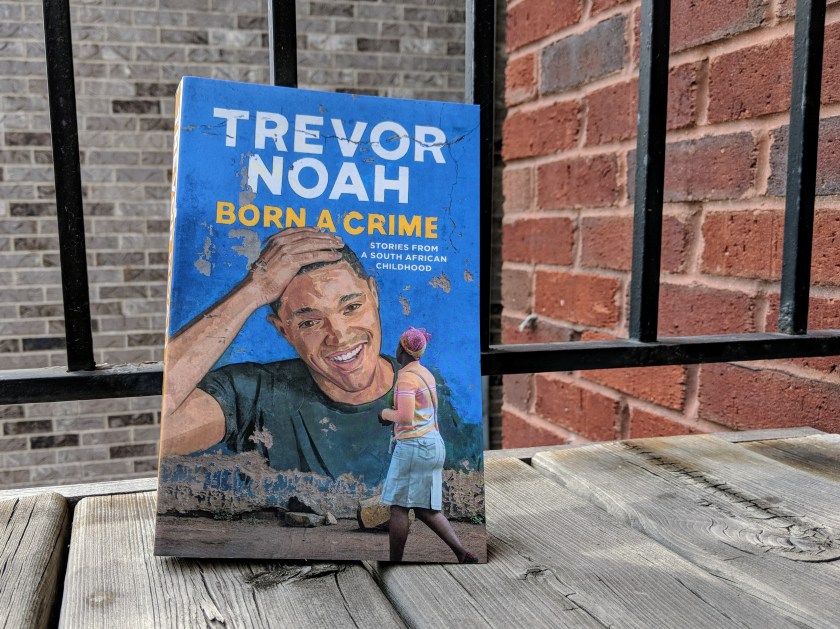
First things first, I loved this book. After hearing people rave about the audiobook version, I decided to give it a shot. (I mean, who doesn’t want to list to Trevor Noah on their way to work and while making dinner?) I’m fairly new to audiobooks, but this one might be my favorite so far. Noah was able to convey his story as only he can, with perfect inflection, comedic timing, and emotion in his voice. The story kept me engaged the entire time, and my mind tends to wander easily.

Noah’s story is an incredible one, and he did a phenomenal job of injecting just the right amount of humor to lighten up even the most intense situations. In fact, (if you’ve read it, you’ll know just the scene I’m talking about) one particular story toward the beginning of the book had me laughing out loud in the car (I’m sure the other people on I-95 thought I was nuts).

But this book isn’t just humorous and entertaining, Noah’s life story is an important one. One of race and class and the impact those have on both individuals and the community itself. Basically, read it if you haven’t. And if audiobooks are your thing, definitely give it a listen.

A Heavy Kind of Funny

When I read and review a book that I love, one of the most common compliments I give is “I read this in one sitting” or something similar. Born a Crime was quite the opposite. It’s a book that I love that took me forrrevvvverrrrr (in my world) to read. My husband actually commented about how few pages I was able to read in one sitting each night.

So why did it take me so long? I think that, for a humorous book, it was heavy and it felt too dense to read quickly. I wanted to take it one chapter at a time and really sit with what I’d read. Obviously, apartheid and racism are not new to me, but South African history is certainly not my area of expertise and a lot of the details were new. I just needed time.

{Spoiler alert: this paragraph has them!} Noah’s story is simply incredible. That one person lived all of those stories is almost mind-boggling. And even more so when you think about the fact that there are definitely stories and parts of his life that are missing from the book. And when you get to that last chapter – wow. Early on in the book, he casually mentions that Abel would at some point shoot his mom in the back of the head. I remember catching my breath and thinking how sad that his mom was murdered by his stepfather… but she wasn’t (thank God) and that makes the story even crazier! I won’t spoil it more than that, but the entire situation with Abel just made me angry and disgusted.

And now I am going to say the most cliché thing I can (and something I am fairly certain I said in my review of The Hate U Give as well). If you’re looking to read a book that is inspiring, funny, thought-provoking, and (here it is) relevant – Born a Crime has you covered.

Humor and Heart

Our April book Born a Crime was just what I was in the mood for! After lots of dark and cloudy months and some intense books (i.e. Birdbox, The Hate U Give, The Healing of America), Trevor Noah’s ability to make anything into a joke was just what I needed. He covers some really dark subjects to say the least (attempted murders, carjacking, domestic abuse, apartheid, racism, etc), but manages to tell his stories with humor and heart.


“One day as a young man I was walking down the street, and a group of Zulu guys was walking behind me, closing in on me, and I could hear them talking to one another about how they were going to mug me. ‘Let’s get this white guy. You go to his left, and I’ll come up behind him.’ I didn’t know what to do. I couldn’t run, so I just spun around real quick and said, ‘Yo, guys, why don’t we just mug someone together? I’m ready. Let’s do it.’ They looked shocked for a moment, and then they started laughing.”


My only criticisms would be that at times his stories were a little repetitive, and I wish he’d gone into more detail about how his childhood led to where he is now. I kept waiting for his stories to jump time and tell us about how he started in comedy and TV hosting, but he never went there. Understandable I guess, considering the title of the book it’s more focused on the story of how he grew up.

Born a Crime was well written and Trevor Noah’s stories were moving, hilarious, heartbreaking, and wonderful all at the same time. He also introduced South Africa as its own character, speaking to many of his country’s complexities built out of a violent history of colonialism and apartheid. My understanding of South Africa and apartheid was minimal before reading this book, and it’s arguably still minimal. But Noah’s stories made me want to learn more.

I highly recommend this one! A humorous memoir that will teach you a thing or two.