Latest Posts

Great Writing, Important Message

Let me begin by saying that I am not yet finished with Between the World and Me. I think the lack of chapters is throwing me and making me take longer that I normally would. Couple that with the fact that I want to unpack, analyze, and process every single sentence, and here I am – still reading. So perhaps my review is not worth as much as another’s, I don’t know. If you don’t trust what I’m saying here, read Katherine C.’s review 🙂

Ta-Nehisi Coates is clearly a skilled writer and is able to craft a narrative that is at once poetic, emotional, and eye-opening.

Things I believed merely a week earlier, ideas I had taken from one book, could be smashed to splinters by another.

But it’s the message of the book that makes this book important. The writing is gorgeous, yes, but what it says is jaw-droopingly, heartbreakingly, painfully honest and agonizingly real.

And this is not reducible to just you – the women around you must be responsible for their bodies in a way that you will never know. You have to make your peace with the chaos, but you cannot lie. You cannot forget how much they took from us and how they transfigured our very bodies into sugar, tobacco, cotton, and gold.

I cannot claim to truly understand his life, his pain, or his struggle. But I can try. And I am trying. And I will try. And you should too. So read the book, and even if you don’t like it, at least you heard the message

An Absolute Must-Read!

I can’t say enough about this book. It’s been on my to-be-read list since it came out. However, I knew I needed to give it my full attention. So, as a mother of a one year old and two year old, I waited until taking a solo trip to read this one. I can remember sitting down with a few books to read the first few pages of each and determine my next read. After picking up Between the World and Me the next thing I knew I was more than 30 pages deep entranced by the writing. But of course, I interrupted by the end of naptime. So finally, during a 48hr trip to Idaho the hours spent waiting in airports and on planes were just what I needed to focus fully on Ta-Nehisi Coates’ Between the World and Me.

The writing is so beautiful, so powerful, so approachable yet weighted with context and complex meaning. And that’s just the beginning. It’s beautifully written, yes, but the message Coates is writing is beyond. Not since reading James Baldwin’s The Fire Next Time in college (another must-read) have I learned so much, underlined so profusely, or been as affected by the testimony of another’s life. In reading this book there were times I was made uncomfortable, angry, sad, inspired, hopeful, regretful, and everything in between. Great books are new stories about unfamiliar people that make you feel things you didn’t know you were feeling. Or things you need to feel. This is a great book. And the added layer that this book is Coates’ letter to his adolescent son as a black man in America makes the reading all the more powerful.

I don’t care if you’re interested in non-fiction, if you’re looking to learn more about race in America, if you know nothing of this book or its author—READ IT! This story is one we need to read, and keep reading more of. But if I can’t convince you, maybe some of Coates’ words can….

“But race is the child of racism, not the father.”

“…The Cabal, The Coven, The Others, The Monsters, The Outsiders, The Faggots, The Dykes, dressed in all their human clothes. I am black, and have been plundered and have lost my body. But perhaps I too had the capacity for plunder, maybe I would take another human’s body to confirm myself in a community. Perhaps I already had. Hate gives identity. The nigger, the fag, the bitch illuminate the border, illuminate what we ostensibly are not, illuminate the Dream of being white, of being a Man. We name the hated strangers and are thus confirmed in the tribe. But my tribe was shattering and reforming around me. I saw these people often, because they were family to someone whom I loved. Their ordinary moments—answering the door, cooking in the kitchen, dancing to Adina Howard—assaulted me and expanded my notion of the human spectrum.”

“And still I urge you to struggle. Struggle for the memory of your ancestors. Struggle for wisdom. Struggle for the warmth of The Mecca. Struggle for your grandmother and grandfather, for your name. But do not struggle for the Dreamers. Hope for them. Pray for them, if you are so moved. But do not pin your struggle on their conversion. The Dreamers will have to learn to struggle themselves, to understand that the field for their Dream, the stage where they have painted themselves white, is the deathbed of us all. The Dream is the same habit that endangers the planet, the same habit that sees our bodies stowed away in prisons and ghettos.”

I urge you to put this on your list, and I hope you get as much from it as I did!

Amazon in Brick and Mortar

Since its beginning in July of 1994 people have said Amazon would put booksellers (and eventually printers) out of business. Well, against all odds, it hasn’t happened. And with people like us out there, we don’t expect it to happen anytime soon, or ever.

In fact, did you know print book sales have been outpacing e-book sales over the past few years? And the next generation of readers is driving this trend. So there’s plenty of room for hope.

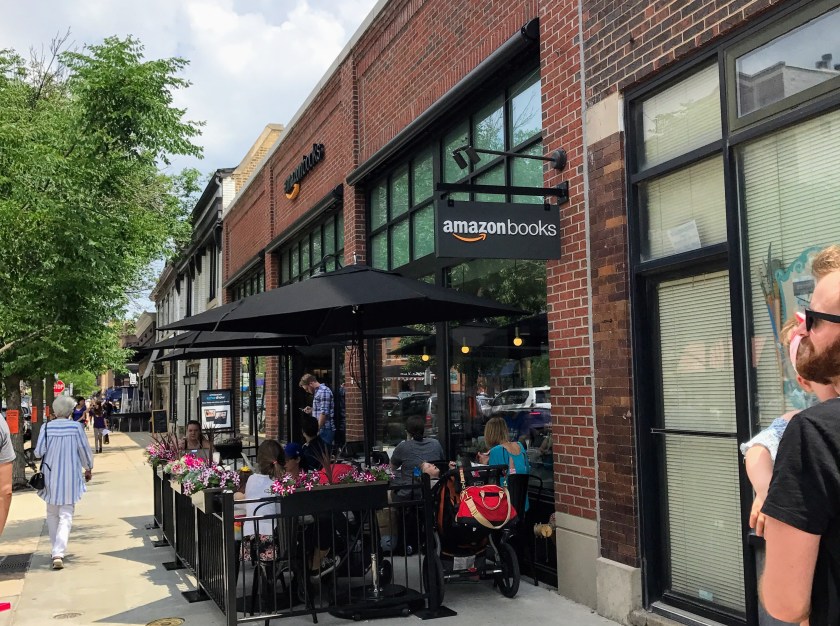
But Katherine C. predicted a new trend that’s now here (check out her masters thesis from 2012 about how digital brands would do well to present their brands in physical space). Since 2015 Amazon has been experimenting in brick and mortar retail by opening physical stores. There are seven open locations (NYC, Seattle, San Diego, Portland, Chicago, and in Lynnfield and Dedham, Massachusetts) with six more opening in 2017. And last week Katherine C. visited the Chicago location. There are more than a few things that make this store very different from other bookstores…

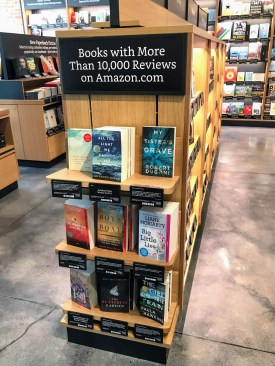
  • All books are rated 4 stars or above from Amazon.
  • The shelves and books are all organized according to algorithm (Amazon bestsellers mostly).
  • The book are all displayed covers-out, it takes up more space but allows for a more fluid experience.
  • Shelves are categorized based on online data, “Hotly debated on Amazon,” “Books Kindle Readers Finish in 3 Days or Less,” “Children’s Bestsellers,” etc.

 

  • The shop keeps their supplies limited, offering less than 100 fiction titles.
  • There’s an electronics section to showcase Amazon electronics (Kindles, and the Echo).
  • All Amazon Prime members get Prime pricing by simply scanning
    a QR code at checkout and selecting your payment option.

But here’s what we think….  this isn’t the place you go to find a book. Odds are they won’t have what you’re looking for and you’d be better off browsing at your local shop.

What is the Amazon books shop good for? Well it is the kind of place you come to to learn what good books others are reading, what’s popular with the YA crowd, which cookbooks are getting the best feedback, the best children’s books for every age group, and the most useful pregnancy or parenting resource books.

It’s like walking into a store built on yearbook superlatives. Sure, it’s fun to see who’s most popular, and who was voted “class clown,” but it’s not necessarily a place where everyone will find what they’re looking for. It’s more the experience of walking into a brick and mortar Amazon space that’s fun and interesting. but we don’t think it’s anywhere close to putting your local shop out of business.

There’s a great New Yorker article about the latest NYC Amazon store that put it best:

It is reminiscent of an airport bookshop: big enough to be enticing from the outside but extremely limited once you’re inside… The store’s biggest shortcoming, though, is that it is so clearly not intended for people who read regularly. I normally walk into a bookstore and shop the way a person might shop for clothes: I know what I like, what generally works for me, what new styles I might be ready to try. It was a strange feeling, on Thursday, to do laps around a bookstore without feeling a single unexpected thrill. There were no wild cards, no deep cuts, no oddballs—just books that were already best-sellers, pieces of clothing I knew wouldn’t fit me or that I already owned.


July Book

Image © Foreignpolicy.com

This month we read to learn more about our Nation’s heritage with a good nonfiction book. There are many, many stories that make up who we are as a country. And it’s a goal of ours to keep educating ourselves on where we come from and who we are by reading a new one of these stories every year. This year’s is one from Ta-Nehisi Coates in the form of his acclaimed National Book Award winner and finalist for the 2016 Pulitzer Prize for General Non-Fiction, Between the World and Me.

This short, yet extremely powerful, 152-page book was published in July (fitting) of 2015. Coates was inspired to write the book after a meeting with President Obama in 2013 and reading James Baldwin’s 1963 The Fire Next Time. Between the World and Me is a series of letters from Coates to his son, Samori. In these letters Coates examines the notion of race in America and how it has shaped our history, most often at the cost of the bodies and lives of black men (and women). The author, a writer for The Atlantic, tackles both personal and historical events that plainly summarize the terrible history of racism and the subjugation of black lives in America.

Now, just as at any time in our troubled history, is the time to do more, be more, read more. We hope you’ll read with us this month. This is arguably the most significant book we’ve read thus far. But if we can’t convince you, maybe Toni Morrison can:

“I’ve been wondering who might fill the intellectual void that plagued me after James Baldwin died. Clearly it is Ta-Nehisi Coates. The language of Between the World and Me, like Coates’s journey, is visceral, eloquent, and beautifully redemptive. And its examination of the hazards and hopes of black male life is as profound as it is revelatory. This is required reading.”

Please read with us and share in the conversation using #booklymark.


Quick and Uneasy

Salt to the Sea was definitely a quick read, but left me a little uneasy. Honestly, I wish I hadn’t known so much about the fate of the Wihelm Gustoff before reading. Because I knew that this ship, [SPOILER] the end of these fictional characters’ pilgrimage, met a terribly tragic end in real life, I read the entire book at arms-length. I fought attachment to any one story or character for fear I’d be disappointed in the end. I think this sullied my reading of the book a bit, and it’s why I wish I hadn’t known at about the great maritime disaster before picking it up. 

So, for any future readers, I’d recommend not reading anything about the historical event this book is based on before you start. I think it would make for a freer (less anxious) reading experience.


“How foolish to believe we are more powerful than the sea or the sky.”


That being said… I did like the book. Although a quick read, I kept postponing my progress. I was too afraid of the ending. But it turns out I didn’t need to be THAT fearful. Like any historical fiction based on wartime struggle there’s of course some tragedy, but nothing that ruined my opinion of the book overall. It’s written in short chapters, each told from the alternating perspectives of different characters. And the characters stories are all rich, heart-felt, and somewhat mysterious. The length did feel a little awkward to me… I wish it’d been longer (more back stories and resolution at the end) or a little shorter (a little less waiting to board the ship, etc). But overall I liked the story, the characters, and the ending. However uneasy I felt about how things would turn out, I was content with the ending. Happy, even.

So if you’re looking for a quick YA read with good characters set in a historical fiction landscape…. this is the perfect match!

Happy reading 🙂

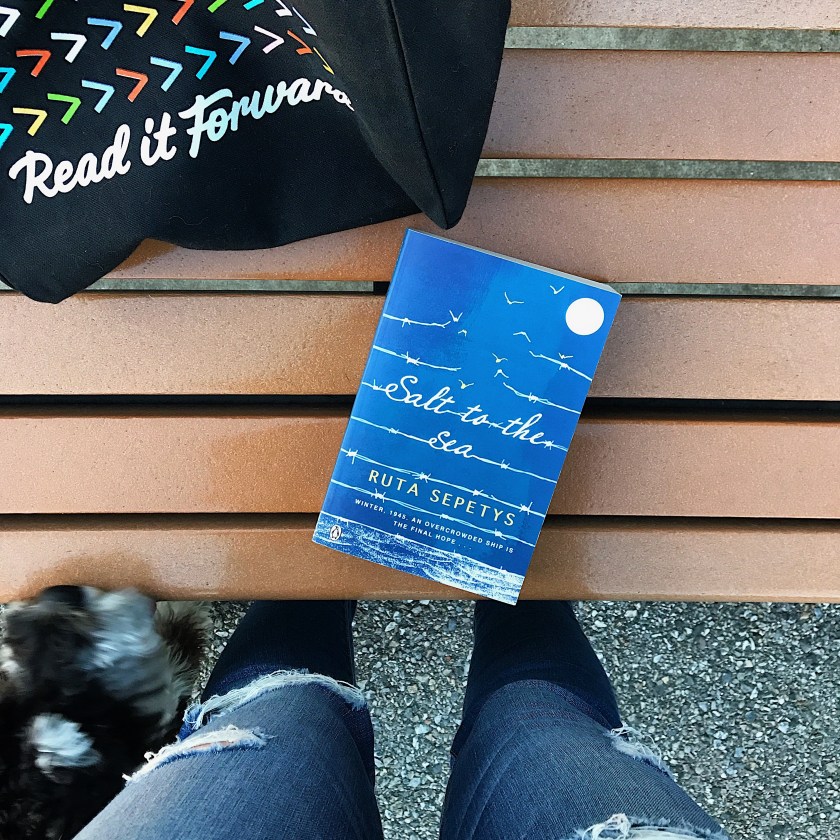
picture of Salt to the Sea on a bench

Consider My Heartstrings Pulled

For years I’ve claimed to not like historical fiction. This book might be the one to change my mind.

I’d heard it was wonderful, touching, a can’t miss, etc. etc., but for some reason I still put it off, fearful I’d have to force my way through. BUT, I am happy to report I was 100% wrong — I was hooked from the first few pages, and flew through the story in five days (which is fairly quickly for me).

When I first started, I was worried I’d have trouble keeping track of the characters and their ever-changing perspectives. It turns out that was quite the opposite. The way Sepetys developed each character, slowly revealing their stories — and struggles — made me eager to keep reading, long past my bedtime. Each character was so compelling — yes, even, Alfred — I couldn’t help but cheer them on as they made their journey to what they hoped would be a better future.

And can I just say, that last chapter (don’t worry, no spoilers!) KILLED me. I was so happy we got a little bit of a conclusion. #allthetears

Needless to say, I’d highly recommend Salt to the Sea, even if — like me — you aren’t a fan of historical fiction or — also like me — aren’t a huge reader of YA. Sepetys’ does a masterful job of drawing you in and making you emotionally invested in every page.

Has anyone read her other books? I’m thinking I might have to add them to my wish list.

Salt to the Sea: Devoured

I love World War II fiction. Quite frankly, I enjoy reading about World War II regardless of whether it is fact or fiction. The fact of the matter is, even novels and other works of fiction about World War II contain so many elements of truth that it feels incredibly real. Of course, I sometimes find it difficult to admit that I enjoy this type of literature, because what does that say about me? That I like reading about such an atrocious time in our world’s history. But if we never read about it, we don’t think about it. And if we don’t think about it, we are doing a disservice to everyone who was affected by it.

Now that you know that little fact about me. I’ll get right to it. I loved Salt to the Sea. I knew nothing of the Wilhelm Gustloff before reading this book except that it was a German ship that sunk toward the end of the war. So this book served as something of an education for me, and I love to learn.

I also love a good romance. A GOOD romance. And this felt to me like a good romance. I really loved watching Florian and Joana develop as individuals and as a unit. I love that they found each other and I love that they (SPOILER ALERT) formed a family that honored the legacies of those characters that didn’t make it.

All that being said, when I was nearly done with the book, I said to Katie C., who was traveling with me, “Did you feel like you were reading a book about the sinking of a World War II ship that was based on the movie Titanic?” She laughed, I laughed, I continued reading, and firmly decided that this was a slightly happier, but also tenfold more tragic version of Jack and Rose.

Bottom line: read it. Or if you’re like me, devour it.

Confession Time

I have to admit, like Katie C., I was hesitant going in to this novel. I have complicated feelings about Amy Schumer — I thinks she’s funny, but can only take so much of her. 300+ pages of her humor had me a little nervous.

But here’s my biggest confession: I didn’t finish it. And not because I didn’t like it, but because I wasn’t in to it. I also have made a new promise to myself to stop reading books I’m not enjoying. With over 300 unread books on my shelf (I’m not exaggerating), it’s becoming increasingly clear that abandoning books needs to be something I’m okay with. Otherwise I’ll never come even close to making that unread number smaller.

Maybe at another time when I didn’t have so many other,  heavier books (ahem, Fates & Furies) calling my name I would have been able to muddle through. I laughed out loud a couple times in the beginning, and read some lines out loud to my husband, but like I am with her humor, it quickly became old.

I will say that I was surprised at how personal she got, and while I appreciated it, it also didn’t jive with the rest of the humor. It was hard for me to take her seriously when two seconds ago she’d made a joke about her vagina.

This book will remain on my shelf, and is one I will recommend to anyone who I think might enjoy it. I’m hopeful that come summer, I’ll come back to it. Because we can ALL use a good dose of funny in our lives.

May / June Book

May and June mean school’s out and it’s almost summer! This time of year we like to read a good YA book to celebrate this liberation. Our pick this May / June was selected as the Goodreads Choice Awards winner for the Best Young Adult Fiction in 2016.

Salt to the Sea by Ruta Sepetys is set in the winter of 1945 when four teenagers flee four different homelands for safe passage on the Wilhelm Gustloff, a ship that promises refuge and freedom. And each of the four teenagers—Joana, Florian, Emilia, and Alfred—harbor their own secrets which haunt them at every step of their journey. The paths of these four converge along the way when tragedy strikes.

This book was inspired by the greatest tragedy in maritime history. It’s estimated that as many as 9,400 people died. Sepetys’ book sheds light on this great tragedy through the story of these four young men and women, each fighting for survival and freedom.

Ruta Sepetys

 Sepetys said she wanted to shed light on this event… “Every nation has hidden history, countless stories preserved only by those who experienced them. Stories of war are often read and discussed worldwide by readers whose nations stood on opposite sides during battle. History divided us, but through reading we can be united in story, study, and remembrance. Books join us together as a global reading community, but more important, a global human community striving to learn from the past.” And it appears she’s succeeded with Salt to the Sea as the praise seems unending:


“Compelling for both adult and teenage readers. Once again, Ruta Sepetys
acts as champion of the interstitial people so often ignored —
whole populations lost in the cracks of history.”
– The New York Times Book Review

“A superlative novel in four voices. Masterly crafted.”
– The Wall Street Journal

“Sepetys is a master of historical fiction…she once again anchors a panoramic view of epic tragedy in perspectives that feel deeply textured and immediate.”
– Entertainment Weekly

“Ruta Sepetys’s riveting novel is a haunting reminder of an almost-forgotten disaster and the resilience of the human spirit.”
– The Washington Post

“The forgotten tragedy that was six times deadlier than the Titanic.”
– TIME


Read with us! And share using #booklymark


Just What I Needed

If you’re reading my review, I’m going to assume you’ve read Katie C.’s review. I will admit here that I am the one who suggested this book for The Bookly Club, and I was SO NERVOUS to read it because I knew not everyone was so excited to do so. What if it was terrible or disgusting?  Or what if it just made you really dislike Amy? That has happened to me before. I won’t say who, but there is a person I adore(d) whose book I read and it just made me not like them. I was petrified this would happen again and everyone would blame me for making them read an awful book about someone who turned out to be an awful person. I was thrilled when Katie C. like the book.

Because I liked the book, loved it even. When I would chuckle or straight up laugh while looking at my Kindle, my husband would say “Amy Schumer’s book?” And I would snort out a “yes,” and proceed to read him whatever line/paragraph/page made me giggle.

Saying that The Girl With the Lower Back Tattoo was funny is almost pointless. If you like Amy Schumer, you’ll think the book is funny. If you’re not a fan, you still might find it funny. If you really really don’t like her, you probably won’t read this book. Bottom line – I would venture to guess that if you have chosen to read the book, you will laugh at least once, hopefully more than once.

What I loved about the book was that she was vulnerable, honest, self aware and so incredibly relatable. I found myself highlighting all over the book. She would occasionally say something profound (see second pull quote in Katie C.’s post). She would occasionally make the most perfect metaphor/description (e.g., “[Women] are basically unpaid geishas”). And damn if this book wasn’t a feminist rally cry. Multiple times I thought, “Yes! Women! We are amazing!”

Making a new friend. When you’re over your twenties it’s hard, but once in awhile someone comes along that you really want to invest time in and it’s so special.

I could point to so many individual passages or chapters that I enjoyed, but I’ll stick to one. In “Athletes and Musicians,” Amy writes, “I’ve always assumed that men see me as just one of the guys, so when someone is interested in me as a girl I’m floored. This hang-up has gotten better over time, but it’s not completely gone.” I could have written that last sentence. I’m guessing so could all of you. Maybe you’re convinced your one of the guys. Maybe, like me, when you are in a group that is being reprimanded, you assume that you are the actual problem, even if you know there is literally no possible way that you were involved in this problem. But maybe they think it was you? My point is, everyone has their “thing” that they just can’t shake. And it was so refreshing to read something written by someone who is as self aware as Amy.

This was my first experience of the stripped-down, cold, unprotected space where vulnerability meets either confidence or shame. It was my choice, and I had to learn (I’m still learning) how to choose to be proud of who I am rather than ashamed.