Latest Posts

Everything I Didn’t Know

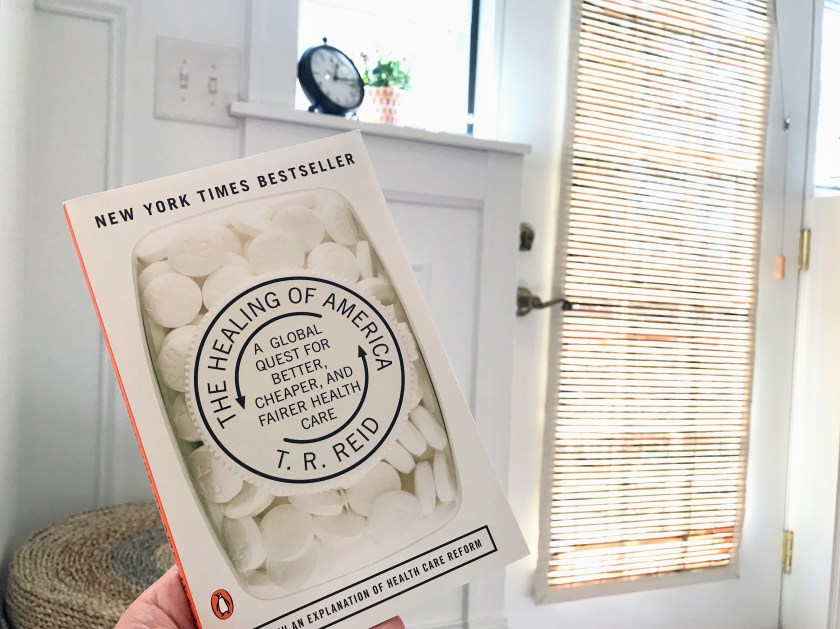
I’ve never read a book like this before. Historically, the non-fiction books I’ve read have been about a person, places, a period of time. But this is the first time I’ve read such an in depth study of a particular policy. In case you missed it, “The Healing of America: A Global Quest for Better, Cheaper, and Fairer Health Care” by T.R. Reid is a examination of our health care system in contrast to others around the world. And it was fascinating.

“Economic growth is not the sole aim of out society… The value of a human life must be decided without regard to… economic considerations. We must take into account the human and spiritual aspects involved.” The Hall Report, 1964

There are a few things I know for certain: our health care system is broken, there are too many Americans without access to health care, our country’s approach to health care is far too politically leaning when it should be a moral issue. But besides that, my knowledge was fairly limited. This book put context and statistics behind the facts. Although we can agree that our system is broken, I feel like the general public has limited exposure to the ideas of what a “fixed” system could look like. But this book changes the game. Starting with all the ways in which our system is broken. Here are just a few of the things that I learned:

  1. We’re the only developed country in the world that doesn’t guarantee all our citizens access to health care.
  2. We spend the MOST in the developed world on our health care system (17% of our GDP).
  3. We’re ranked 37th by the World Health Organization in health care quality and access.
  4. We’re the only developed nation that would limit, or revoke, access to health care based on the fact that you actually need care (ahem, pre-existing conditions).
  5. We run the truest form of socialized medicine in our Veterans Affairs, Medicare, and Indian Health Service health care systems.
  6. 45 million Americans are uninsured.
  7. Our physicians pay upwards of ten times what physicians in other countries pay in malpractice insurance.
  8. While our physicians can come into the workforce with somewhere around $200,000 in debt, the physicians in most other developed countries have their education paid for.
  9. Because of how efficient the health insurance programs are in other countries—they spend a lot less time coming up with reasons to deny claims—their administrative costs are somewhere around 3-5% whereas the U.S. agencies spend around 20%. So for every $100 you spend on health insurance $20 goes to administrative efforts.
  10. I could go on (and on) but I’ll stop here.

All of the flaws listed above have been fixed in ALL other developed countries. Sure, the cost of the health care systems in these countries is high, but they still spend less that the United States. And sure they save a lot of money by regulating the compensation of doctors and nurses (which is a problem yet to be solved). However, those men and women are debt free, spend a TON less in administrative costs (in France they don’t even need filing cabinets because all patient information is accessed via an encoded chip on the patient’s “Carte Vitale”), and spend barely anything on malpractice insurance. So, when you think about it, it’s kind of like a cost of living difference. So even though there are some kinks, I still think cost of universal health care is WELL worth the risks.

“The Beveridge Model of health care has been adopted, with variations, by nations around the world, democracies and dictatorships alike. A system in which government owns the hospitals, pays the doctors, buys the medicine, and covers all the bills would probably come pretty close to what American politicians have in mind when they deplore ‘socialized medicine.’ But American, too, has copied the NHS model—to provide treatment for tens of millions of Native Americans, military personnel, dependents, and veterans. With government doctors in government clinics dispensing government drugs (and no bills for the patients to pay), the U.S. Department of Veterans Affairs is one of the purest examples anywhere of the Beveridge Model at work. If this is un-American, why did we choose it for America’s military veterans?”

But back to the book. I think you’ve already gathered that the amount of information it holds is staggering, useful, and fascinating. But beyond that, Reid writes from very personal experiences. He’s lived, worked, and used the health care services in all the countries he studies (UK, Germany, Japan, India, Canada, US, France). He shares his stories and conversations with real doctors, and real patients. In these real world scenarios it becomes even more astounding how the United States, with its claims of liberty and justice for all, can still be a country that limits its peoples access to health care. To me it all comes back to issues of racism, sexism, and ageism, but that’s another issue for another day.

You should read this book. Sure, it’s a little repetitive at times. But even if it’s just a chapter every once in awhile. Even if it’s just chapters 2, 3, and 13 (good summaries / big picture chapters). Even if you totally disagree with everything I’ve said up to now, read it. “The Healing of America” is a fascinating study of the modern system that is health care. But if you do nothing else, just ask yourself this question: is health care a human right?


 

Hot Mess Redemption

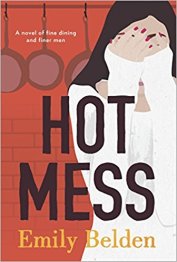
emilybeldenAs Bookly’s first ARC, courtesy of Graydon House (thank you!!), “Hot Mess” by EmilyBelden was our perfect match. It’s the story of Allie Simon, a young woman living in Chicago amidst her quarter-life-crisis of sorts. As you may (or may not) know, Bookly is made up of four Katherines from different cities who run this book club together. And I happen to live in Chicago (it’s me, Katherine C.)! Even more fitting, one of my daughters shares a name with the author (her middle name, Belden, named after a street we lived on for years).

So it felt meant to be, and right away I volunteered to read “Hot Mess.” Although, to be honest, I had my doubts. I like to think I have fairly diverse taste in books, but anything under the Harlequin umbrella is not really in my wheelhouse. So I had no idea what to expect. And it was a bit of a rocky start.

51hS-E6r92L._SX334_BO1,204,203,200_

Allie Simon’s story starts when she’s only months into a relationship with Benji Zane, the latest and greatest star on the Chicago foodie scene. He’s covered in tattoos, sports a man bun (not my thing), flies through life with unblinking confidence, and is well known for having a raging cocaine problem. So despite Allie’s infatuation, all signs point clearly to disaster. And that’s where I struggled in the beginning. Benji is a controlling, co-dependent, unlikable, narcissist who tweetes a sext of Allie’s as his official girlfriend announcement. So when nearly two-thirds into the book Allie is still pining for this wreck of a love interest, I was worried this might actually be the story of Allie’s näiveté. Could she actually end up with this guy? Was this one of those love stories where the woman successfully “fixes” the man, setting more unrealistic expectations for women in relationships (ahem, Fifty Shades of Grey)? If that was the case I was ready to drop the book right then and there.

But Belden has written a story that’s more complicated (and feminist) than I ever suspected. Without giving too much away, I will say that “Hot Mess” far exceeded my expectations. Even through the frustrations of Allie and Benji’s relationship I was hooked. I had to know what happened to Allie (I didn’t care for a minute where Benji ended up). Belden’s writing kept me interested in the fate of Allie’s relationship, and most importantly her career. That’s what you may not realize, at its heart this is the story of a young woman figuring out her career path, and coming out of her mistakes stronger. And kind of a badass, actually.

I loved how Belden wrote Allie’s story so that at first I was yelling at her, “why are you being so stupid?!” But by the end she’s a kick-ass a character you feel, weirdly, proud of. And there’s no lack of strong women in this book, which I loved! Allie’s counterparts Angela and Tabitha are great characters. Angela specifically is one who I’d love to see played out on screen. Her mixture of vulnerability, strength, know-how, and sarcasm was very entertaining. Not to mention how fun it was to read about all the Chicago details! I also love Molly’s Cupcakes, and this book had me craving their red velvet cupcake with vanilla cream cheese frosting (yummm).

So if you’re ever in the market for a story with a complicated, smart, successful female lead who experiments in love and delicious food, this is it. I’m excited for this one to come out (March, 2018!), I think it’s a great spring/beach read and I can’t wait to see what else Emily Belden has in store! And thank you again to Graydon House for sending this one our way!

Commonwealth: a nation, state, or other political unit

“It’s like this enormous tree had just crashed through the house and I was picking up the leaves so no one would notice what had happened.”

I read this book early last year, so details are a little fuzzy BUT, I do know that I LOVED it. I read it in one day, one sitting, becoming completely immersed in the lives of the Keating and Cousins family.

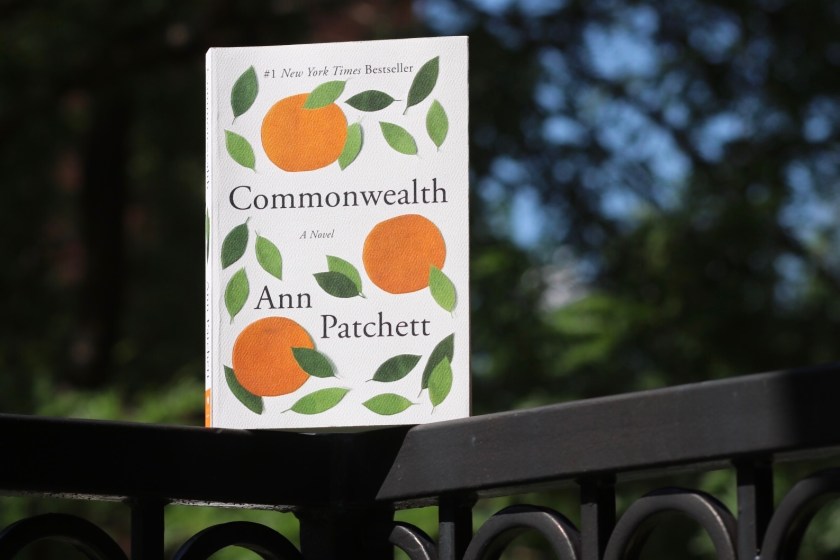
Ann Patchett is one of my favorite writers (if you haven’t read This is the Story of a Happy Marriage, DO IT). She has a way of setting the scene that makes you feel as if you’re right there, which is exactly what she did in Commonwealth. From the first chapter, I could picture myself at Franny’s baptism, I could smell the gin, I could taste the oranges. And I was hooked.

While I’m not always a fan of stories where nothing happens, the character development and the relationships between these complicated families — not to mention Patchett’s beautiful writing — had me flipping the pages, eager to become as much a part of the Cousins/Keating clan as I could.

But while Commonwealth is undoubtedly a story of family, and one family in particular, it’s also the story of how a single person’s actions can reverberate throughout the rest of the family, and for years into the future.

As someone with a small family (one sister, one first cousin, one aunt, no uncles), I’ve always been drawn to portrayals of big, loud, messy ones (think “Parenthood,” “Brothers & Sisters,” This is Where I Leave You, “The Family Stone,” Little Fires Everywhere), and this one stuck with me. In fact, over a year later I still think of the characters, especially Franny, and wish I knew how they were doing. Ann, any chance of a sequel?

If you like escaping into someone else’s family drama, pick this one up. It’s particularly good for this time of year — a warm, cozy, absorbing read.

What’s it about? Stuff. Really good stuff.

Commonwealth is an uncommon read.  It revolves around a family that is uncommon but somehow not uncommon at all. The relationships between families divided and rebuilt with scraps is a universal theme. Even if you come from a family never split by divorce, you definitely have something off about your family. (If you think there is nothing off about your family, you are probably the thing that is off about your family.) Through the complex narrative that Patchett slowly unfolds, you can find pieces of the story that make you feel at home – sometimes the chaotic, dysfunctional version of home that so often defines our family.

It speaks to the excellence of Ann Patchett’s writing that she could develop little stories and relationships and build it into something greater than the sum of their parts. It is the way she describes seemingly innocuous parts of the scene that drew me in.  Describing a single mother’s struggles – “She was always arriving, always leaving, never there.” It’s an enormously complex struggle synthesized into one sentence.

One of the things I love that this book does is show how trauma changes everyone. Every child grew into some divergent version of the person they were before Cal died. Loss is something that we all must live through, but loss is the thing we all experience differently. “Life, Teresa knew by now, was a series of losses. It was other things too, better things, but the losses were as solid and dependable as the earth itself.”

I really enjoyed this book. I would definitely recommend it to others.

December / January Book

It’s that time of year when your calendar starts to look really cluttered, your to do list grows longer, and you start to consider resolutions for the new year. Well, every year we resolve to read a book that teaches us something new. And something we all need to learn so much more about is our country’s healthcare system.

So, the December/January book we’ve picked is T.R. Reid’s The Healing of America: A Global Quest for Better, Cheaper, and Fairer Health Care. It’s a brief 250 pages with chapters like “Different Models, Common Principles,” “Too Big to Change,” and five separate chapters examining the systems of different countries (France, Germany, Japan, Canada, the UK). Also, there’s an afterword titled “‘Obamacare’ Explained,” which we all need to read. Anyone else feeling like our healthcare system is intimidating and confusing?! We feel like reading this is a step in the right direction.

The author Reid is a career journalist who, for this book, visited over half a dozen different countries to examine their health care and use each one to illustrate the successes and failures of different models. His overarching theme is contrasting the various health care systems of the developed world with the United States.

Let’s be honest, our system is most clearly broken. We have a lot to learn, both about what works in other countries, and what doesn’t in ours. With all the dialogue going on about health care in our country, it’s hard to differentiate fact from fiction. But all of us at The Bookly Club are interested in learning more. Outside of many other factors (including the fact we’re all women whose rights are at risk with new legislation), one of us is a physician, one has a serious pre-existing condition, one is married to someone with a chronic pre-existing condition, and another works with children with special needs. We all (yourselves included) need to learn more about this mutating beast that is health care. A system so many of our lives depend on.

We hope you’ll read along with us and learn something new. When you read along, please share using #booklymark!

Everything and Nothing

Though I bought Commonwealth in mid-May, I didn’t start reading it until a few days ago. Mostly because I wasn’t sure I would like it. I had read a few reviews and talked to a few people who said variations of, “it took me a long time to get into it,” or “I couldn’t relate and didn’t connect with any of the characters.” I was dreading reading a book that I wouldn’t enjoy. Fast forward to November 26 when I decided to start it, with every intention of not finishing and writing a review that said exactly that.

But lo and behold – I was hooked from the outset. I read the first quarter in one night, the next third the following night, and finished the rest over the next two days. Don’t get me wrong, it was not without its faults. The narrative device somehow made it feel like nothing was happening when in fact so much had happened that it was hard to believe. As I described it when discussing with the other Bookly Clubbers – it’s almost like listening to your friend tell you a story about their cousin’s friend. You don’t really have a connection and you sort of nod along and react appropriately. And then later, when you recount the story to yourself, you think, “Holy $#%& those people lived through hell!”

But, I was touched. Most particularly by Albie’s redemption story. To read about a heroin addict who pulled himself back together and found family again, even just a bit of family, just wrenched my heart. But also by Franny’s journey. Though I found her betrayal of her siblings and family to be loathsome, I also found it easier to forgive her because of the guilt she felt, her support of Albie, and the love she gave to her stepchildren. I was happy that Fix seemed to find long-term happiness with Marjorie after dealing with Beverly’s awfulness. And though we didn’t get to know her, really, I laughed out loud that Bonnie ended up marrying Father Joe Mike. I loathed Beverly and Albert, and was simply disgusted at the way they treated their children and how little they seemed to care about them. But, interestingly, by the end, I found myself thinking that maybe they weren’t so bad (they were, but in their old age they got a little less so).

And then it ended. And the ending felt abrupt. And it was a little disappointing. I was actually confused when I turned the page and found it said “Also by Ann Patchett” instead of a few more pages, or paragraphs, or even sentences. It’s not that the ending was bad, it wasn’t. It wrapped everything up in a logical way. But it was just… abrupt.

The End


(See what I did there?)

Uncommon Read

This book surprised me more than most. I know Commonwealth has been talked up for the past year (or so) since it’s release, but I wasn’t expecting too much. From all the descriptions I predicted it would be a relatively uneventful story about a complicated family and their 300+ page journey to right the wrongs of their past. Seemed like a story I’d already read before, and not much more. It was all of those things, but also more. Not to say those qualities by themselves aren’t enough for a good book, it’s just not what I was in the mood for. Current events leave me wanting for something more escapist, and Commonwealth throws you right into the beast of the realities of family, regret, and mortality. But in the best way…

This is the first Ann Patchett novel I’ve ever read so I wasn’t sure what to expect from her writing. I thought it’d fall somewhere between Judy Blume and Sylvia Plath. And all things considered I think I was pretty spot on with that one. I loved her writing style. The way she unfolds a story and builds your attachments to the characters is so subtle and gripping. She lets you in just enough to each character’s past and present that it makes you feel like you know them, yet want to know more.

When I got to the end of the story of these two families (the Cousins and the Keatings) I started crying. My two-year-old asked me to read to her, so I read her my book instead because I was eager to finish, and I started crying while reading it aloud. The ending doesn’t tie up the story into a perfect package, hit you with a major twist, or hit a huge climax. But it’s simple, romantic, quiet. There was something beautiful about it, and about the whole story. In thinking more about what made the story so moving, for me, I think it’s because Patchett told, so well, the story of the entire lifecycle of one family.

The first few pages begin with Fix, Beverly, Bert, and Teresa starting their families and submerged deep in the lives of parenting babies and toddlers (where I am). And once we reach the end those characters have reached the end of their lives and their once toddling children are now grown, with grown children. So much has happened. The story began as one about Fix, Teresa, Bert, and Beverly, but as life takes its course it becomes about their children. And those children’s lives are now settled, and slowing as well. The book felt like the start and finish of something. And I couldn’t help but feel sad that their story was ending, while picturing my family as it is now, just starting, eventually reaching an end (or new beginning depending on how you wanna look at it). Wow that sounds depressing! But in reading the story, no matter the mistakes or regrets in their lives, there was something beautiful about looking at a family as one complete story with a beginning and an end. Fulfilled.


So I definitely recommend this one to you all! I hope you enjoy it as much as I did.

November Book

We’re back again, as we are at the beginning of every month, to announce our book for this month! This is one we’re really looking forward to since it’s been high on our to-be-read list since its release early last year. Nominated as Best Book of the Year by several publications, critically (and publicly) acclaimed, and written by a legendary author, who wouldn’t be excited for our November pick; Ann Patchett’s Commonwealth ?

Spanning the course of 50 years, Commonwealth shows us how one affair affects the lives of the four parents and six children in the Cousins and Keating families as they’re forced to become one blended, bi-coastal family. Spending summers in Virginia, the Keating and Cousins children forge a bond based on shared disillusionment and the strange but genuine affection that grows between them.

But once they’ve grown, these children are ultimately forced to look at their story a different way when it becomes the plot of a best-selling novel authored by Franny Keating’s partner.


This is Patchett’s seventh novel, but her first to be claimed as semi-autobiographical. Patchett herself had parents who divorced when she was young. Her mother then married someone with four children and moved Patchett across the country with her new family. Patchett uses her own memories in writing this novel to raise the question of whether writing fiction based on real events and people is inherently exploitative.

Told with equal measures of humor and heartbreak, Commonwealth is a meditation on inspiration, interpretation, and the ownership of stories. It is a brilliant and tender tale of the far-reaching ties of love and responsibility that bind us together.

We’re excited to read this one, and we hope you’ll read along with us! When you do, share your pictures and thoughts using #booklymark 🙂

Bum Bum!

Ok so I totally agree with Katie – this is like an SVU episode. Which I love. Except that there is no Stabler. This book has no Stabler. So you can stop reading here.

Just kidding – this book is not going rewire your whole literary life but it is fun, it is creepy, and it is a great autumn evening read. Brian Freeman hits the ground running from the first scene.  Probably the thing that he does, that I love the most, is that he keeps the story moving. There is very little dead time with the mystery and he manages to do that without making the scenario super convoluted. I mean its a crazy pants story but it isn’t muddled with characters or asides or distractors.

Part of the downfall of the pace of the story is that not too many characters are well flushed out. Frankie – I thought she had to be a secret crazy psycho because she had so little of anything going on with her.  She had a weird job and had a bad childhood but was kind of like wet paint drying. Maybe that was intentional to make room for Mr. Frost Easton because has some legs to him. But he’s not quiet there. He’s the complicated hero with more stories to tell but we got very little of that. The only other flushed out character was San Francisco. She’s the perfect backdrop to the Night Bird story.

I like it for the fun to come with Mr. Easton. Plus we still need to know more about who killed Katie!

SVU: The Night Bird

I’m all about the right read for the right time, and October begs a good, spooky, mystery. The Night Bird was just that. It read like a double episode of Law & Order SVU: the brooding investigator with a haunted past and a strong female professional being victimized by a series of targeted killings of young, innocent women.

The premise is that the “Night Bird” killer is kidnapping, hypnotizing, and conditioning women into reliving their forgotten phobias when they hear Joni Mitchell’s “The Night Bird.” And he’s doing this to women who at some point have been patients of Dr. Francesca Stein; a psychiatrist who specializes in hypno-therapies to rid people of debilitating phobias.

It was pretty easy to see some of the connections early on (phobias, hypnosis, the Joni Mitchell song), and SPOILER I also saw it coming that Frankie’s husband was cheating on her with her sister and that the death of Frankie’s father was less than innocent. But this made me think the larger mystery would also be easy to solve, and then I would have thought the book was pretty uninteresting. But I was wrong.

I could tell who the “Night  Bird” was NOT, but I never guessed who it was, which made me like the book even more! It bums me out when I’m able to figure out the end. And I liked the twist with Frankie’s sister, I didn’t really see that coming. Overall, I thought it was a good mystery. But I will say, I think the characters were a little loose, not enough meat. Or maybe just not relatable enough for me? Also, I expected there to be something to tie in Frost’s sister’s murder. But I guess that’s just a character backstory to last Freeman through more books in the detective Easton series (which was in fact confirmed by the author in a comment on one of our Instagram posts). All-in-all I’d say this was definitely a great October read!